In the relentless race to get products to customers faster, warehouse storage is increasingly being recognised not just as a cost — but as a source of delay. Every hour a product sits on a shelf between arriving from a supplier and leaving for a customer is an hour of lead time that is costing your business money and potentially costing you a sale.
Cross-docking is the logistics strategy that eliminates that delay entirely. Rather than receiving goods, putting them away on racking, picking them later and despatching them, cross-docking moves products directly from inbound to outbound — often within hours of arrival. No storage. No put-away. No unnecessary handling. Just fast, accurate, cost-effective throughput.
This guide explains exactly what cross-docking is, how it works, the different types of cross-docking, which businesses benefit most from it — and how EMFH provides cross-docking as part of our Nottingham 3PL operation.
What is Cross-Docking? A Clear Definition
Cross-docking is a logistics and supply chain practice where inbound goods from a supplier, manufacturer or distribution point are received at a warehouse or fulfilment centre, immediately sorted and consolidated, and then loaded directly onto outbound vehicles or despatch routes — without entering long-term storage.
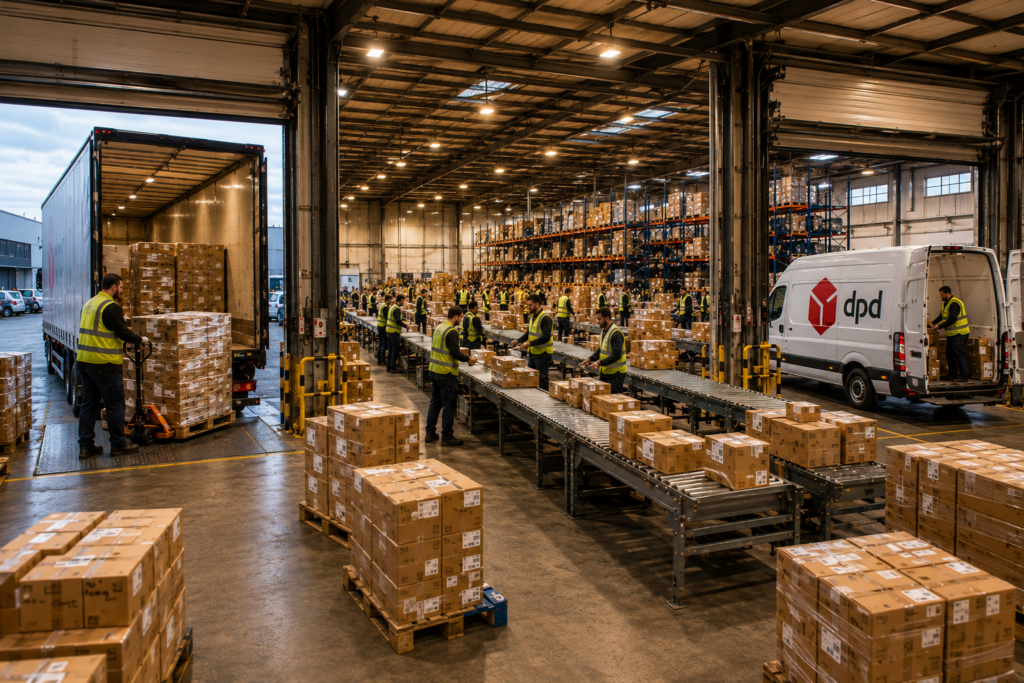
The term comes from the physical layout of a cross-docking facility: goods arrive through one set of docking bays (inbound), are moved across the warehouse floor and leave through another set of docking bays (outbound) — crossing the dock rather than being stored within it.
In a traditional fulfilment model, a product’s journey looks like this:
- Supplier ships goods to warehouse
- Warehouse receives, scans and puts goods away on racking
- Goods sit in storage until an order is placed
- Picker picks goods from racking
- Goods are packed and despatched to customer
In a cross-docking model, steps 2, 3 and 4 are compressed into a single action:
- Supplier ships goods to the cross-docking facility
- Goods are received, sorted and immediately allocated to outbound orders or routes
- Goods are loaded onto outbound vehicles and despatched
The result is a dramatically shorter lead time from production to customer, with significantly reduced handling, storage costs and risk of damage or error.
The Different Types of Cross-Docking
Cross-docking is not a single, fixed process — it takes several different forms depending on the nature of the goods, the supply chain and the business requirements. Understanding which type applies to your situation is important when evaluating whether cross-docking is the right strategy.
Pre-Distribution Cross-Docking
The supplier or manufacturer pre-sorts goods before despatch, labelling each unit or case for a specific end destination. When the goods arrive at the cross-docking facility, they simply need to be verified and loaded onto the correct outbound vehicle. This is the fastest form of cross-docking and requires the tightest coordination with suppliers. It is widely used by major retailers and grocery chains.
Post-Distribution Cross-Docking
Goods arrive at the facility unsorted. The cross-docking operation receives the inbound delivery, sorts the products according to outbound orders or distribution routes, consolidates them and loads them for despatch. This is more flexible than pre-distribution cross-docking as it does not require supplier pre-sorting, but it involves more handling at the facility.
Opportunistic Cross-Docking
This is a hybrid approach where a warehouse management system identifies — in real time — that a specific inbound delivery contains items that are already allocated to live outbound orders. Rather than putting those items away into storage, the WMS flags them for immediate transfer to the outbound packing area. This is increasingly common in modern 3PL operations and allows the efficiency of cross-docking to be applied selectively to the right products at the right time.
Consolidation Cross-Docking
Multiple smaller inbound shipments from different suppliers are received, combined into a single consolidated outbound delivery and despatched together. This is particularly useful for reducing freight costs where individual supplier shipments are too small to be cost-effective on their own.
Deconsolidation Cross-Docking
A single large inbound shipment — for example, a full container load from a manufacturer — is received and broken down into smaller individual orders or route-specific loads for onward distribution. This is common in B2B distribution and retail replenishment operations.
How Cross-Docking Works at EMFH: Step by Step
At East Midlands Fulfilment Hub, cross-docking is delivered as part of our broader 3PL fulfilment service. Here is exactly how the process works when a client uses our cross-docking capability:
Step 1: Advance Shipment Notification
Before goods arrive at our Nottingham warehouse, your supplier sends an Advance Shipment Notice (ASN) — detailing what is coming, in what quantities and when. This allows our operations team to prepare the receiving bay, pre-allocate the inbound units to live outbound orders in our WMS and schedule the cross-docking workflow in advance. The ASN is the critical enabler of a smooth cross-docking operation.
Step 2: Inbound Goods Received and Verified
When the delivery arrives, our team unloads the vehicle, scans every inbound unit against the ASN and verifies quantities and condition. Any discrepancy — shortage, damage, incorrect item — is flagged immediately and you are notified before any goods are processed further. This verification step, while fast, is non-negotiable. Moving incorrect goods straight through to outbound creates errors that are far harder to correct downstream.
Step 3: Sorting and Allocation
Verified goods are sorted according to their outbound allocation. Our warehouse management system matches each inbound unit to its designated outbound order, route or retailer. Units are physically moved to the outbound staging area and grouped by despatch route, courier or customer.
Step 4: Packing and Labelling
Where required, units are packed into appropriate outer boxes or mailers, labelled with the correct courier or retailer-specific labels and prepared for collection. For B2B cross-docking, carton labelling and compliance documentation (delivery notes, ASNs) are generated at this stage.
Step 5: Same-Day Outbound Despatch
Goods are loaded onto the outbound vehicle or handed to our courier partners the same day of arrival. For cross-docking operations that run to our 2pm cut-off, products arrive in the morning and leave the warehouse the same afternoon — often achieving next-day delivery to end customers without ever occupying a storage bay.
The Benefits of Cross-Docking for UK eCommerce and Distribution
Cross-docking offers a compelling set of benefits when applied to the right supply chain and product types. Here is a detailed look at what those benefits mean in practice for UK businesses.
1. Dramatically Faster Delivery to End Customers
Eliminating storage time from the supply chain compresses lead times significantly. For eCommerce brands, this can mean the difference between a three-day delivery and a next-day delivery — without any change to your carrier or your courier contract. For B2B operations supplying retail partners, it means meeting tighter delivery windows and reducing the risk of out-of-stock situations at the retailer level.
2. Significant Reduction in Storage Costs
Storage costs — whether charged per pallet per week at a 3PL or borne as fixed warehouse overheads — are eliminated for goods that move through cross-docking. For high-volume, fast-moving SKUs that turn over quickly anyway, the storage cost savings can be substantial over the course of a year.
3. Reduced Product Handling and Fewer Errors
Every time a product is handled — picked from a shelf, moved between locations, repacked — there is a risk of damage, mislocation or error. Cross-docking minimises the number of touchpoints a product experiences between supplier and end customer. Fewer touchpoints means fewer opportunities for mistakes, and lower rates of damaged or incorrectly despatched goods.
4. Lower Labour Costs
Put-away, cycle counting, replenishment picking and location management are all labour-intensive warehouse activities that cross-docking bypasses entirely for the relevant goods. For high-volume product flows, the reduction in warehouse labour cost can be meaningful.
5. Improved Cash Flow Through Faster Stock Turns
For product categories where the gap between purchasing from a supplier and receiving payment from a customer is critical — fashion, seasonal goods, promotional items — cross-docking accelerates the cash conversion cycle. Stock bought from a supplier on Day 1 can be delivered to a customer and generating revenue by Day 2 or 3, rather than sitting in a warehouse for days or weeks before being despatched.
6. Ideal for Seasonal and Time-Sensitive Products
Seasonal goods — Christmas products, Valentine’s gifting, summer ranges — have a hard selling window. Getting them to market quickly is commercially critical. Cross-docking ensures that seasonal stock moves from supplier to customer at maximum speed, maximising the time available within the selling window.
Is Cross-Docking Right for Your Business? Key Criteria
Cross-docking is a powerful strategy, but it is not universally appropriate. It works best when several conditions are met:
High Product Velocity
Cross-docking works best for fast-moving SKUs that turn over quickly. If a product would be in storage for less than 48 hours anyway — because demand is high and orders are flowing constantly — cross-docking can eliminate even that brief storage period. Slow-moving or uncertain-demand products are generally not good candidates.
Predictable, Pre-Planned Order Flow
For cross-docking to work efficiently, there must be known outbound demand at the point of inbound receipt. This means either pre-allocated orders already in the system or a confirmed distribution plan. Cross-docking does not work well for speculative stock purchases where the outbound plan is unknown at the time of receipt.
Reliable Supplier Performance
Because cross-docking removes the buffer of storage, there is no inventory safety net if a supplier delivers late, in the wrong quantities or with quality issues. Reliable supplier performance — accurate quantities, correct products, on-time delivery — is a prerequisite for a successful cross-docking operation.
Products That Don’t Require Extensive Preparation
Cross-docking is best suited to products that are already in their final sellable state when they arrive — or require only minimal re-labelling or packaging before despatch. Products that require significant rework, assembly or compliance preparation are generally better suited to standard fulfilment with storage.
Good Communication Between Supplier and 3PL
The ASN is the foundation of effective cross-docking. A supplier who cannot provide accurate, timely advance shipment notices makes cross-docking significantly more difficult and error-prone. If your supplier relationships do not include EDI or ASN capability, this is worth addressing before implementing cross-docking.
Cross-docking is particularly well-suited to:
- eCommerce brands with fast-selling SKUs — where pre-allocated orders mean inbound stock can immediately flow to outbound despatch
- Retailers running frequent product drops — where a new range arriving today needs to be available for same-day or next-day delivery
- B2B distributors supplying retail DCs — where large inbound consignments are broken down into retailer-specific deliveries
- Importers consolidating container loads — where a single large inbound shipment is split into multiple outbound routes
- Seasonal and promotional campaigns — where time-to-market is critical and storage time represents wasted selling opportunity
- Subscription businesses on despatch day — where all subscriber orders go out on the same day, allowing inbound stock to flow straight to packing without storage
Cross-Docking vs Traditional Warehousing: Which Do You Need?
Cross-docking and traditional warehousing are not mutually exclusive. Most businesses benefit from a combination of both — using standard warehousing for the majority of their SKU range and applying cross-docking selectively to the products and circumstances where it adds the most value.
| Factor | Traditional Warehousing | Cross-Docking |
|---|---|---|
| Storage cost | Per pallet per week | None (handling only) |
| Lead time | Depends on stock turn | Same day or next day |
| Product handling | Multiple touchpoints | Minimal touchpoints |
| Demand certainty needed | Low — stock can wait for orders | High — orders needed on arrival |
| Supplier reliability needed | Moderate — buffer stock absorbs variation | High — no buffer stock safety net |
| Best for | Slow to medium velocity, uncertain demand | High velocity, predictable demand |
| Technology requirement | Standard WMS | Advanced WMS with real-time allocation |
The most effective supply chain strategies use cross-docking for the right product flows and traditional warehousing for everything else — and a 3PL with the right technology and operational capability can manage both simultaneously from a single facility.
Cross-Docking and the UK’s Golden Triangle: Why Location Matters
The effectiveness of cross-docking is directly influenced by the geographic location of the facility. A cross-docking operation that can only reach a proportion of the UK’s population within a same-day or next-day delivery window defeats a significant part of the purpose.
EMFH’s Nottingham warehouse sits at the centre of the UK’s Golden Triangle — the logistics sweet spot bounded by London, Birmingham and Leeds that covers approximately 90% of the UK’s population within a standard overnight delivery radius. This means goods cross-docked through our facility in Nottingham can reach virtually every UK postcode by the following day using standard carrier services — without premium next-day surcharges on the majority of routes.
For eCommerce brands and distributors where delivery speed is a competitive differentiator, this central location is a genuine advantage. It is one of the key reasons that Nottingham and the East Midlands have historically attracted major logistics and distribution operations — and why EMFH is strategically positioned to serve UK eCommerce brands from a single, central facility.
Common Questions About Cross-Docking
How quickly can goods be turned around through cross-docking?
In a well-organised cross-docking operation with an accurate ASN and pre-allocated orders, goods can move from inbound receiving to outbound despatch in as little as two to four hours. For EMFH clients operating to our 2pm same-day despatch cut-off, goods arriving in the morning can be despatched to end customers the same afternoon.
Do I need special technology to use cross-docking?
Your 3PL needs a warehouse management system capable of real-time inbound-to-outbound allocation. As a client, you need to be able to provide advance shipment notices — either via your own systems, via your supplier’s EDI capability, or via a simple pre-notification process agreed with your account manager. You do not need your own specialist technology.
Can cross-docking be combined with standard fulfilment for the same account?
Yes — and this is the most common approach. Most EMFH clients who use cross-docking do so for specific SKUs or specific product flows (seasonal drops, promotional stock, fast-moving lines) while using standard warehoused fulfilment for the rest of their range. Both operate from the same inventory account and dashboard.
What are the risks of cross-docking?
The primary risks are supplier-related: late delivery, incorrect quantities or quality issues arriving without the buffer of stored inventory to absorb the disruption. These risks are mitigated by working with reliable suppliers, maintaining accurate ASNs and building contingency plans for the most supply chain–critical product lines. Your EMFH account manager will discuss risk management as part of your cross-docking setup.
Cross-Docking at EMFH: Fast, Accurate and Fully Integrated
East Midlands Fulfilment Hub offers cross-docking as part of our full 3PL service from our Nottingham fulfilment centre. Our cross-docking capability is supported by a real-time warehouse management system, experienced receiving and despatch teams, and a multi-carrier shipping network covering DPD, Royal Mail, Evri, DHL and Whistl.
Every cross-docking client benefits from:
- Same-day processing for goods arriving before our 2pm cut-off
- Real-time dashboard visibility — track inbound deliveries, processing status and outbound despatch from one screen
- Dedicated account manager — a single point of contact who manages your cross-docking operation and communicates proactively if anything needs attention
- Integrated with standard fulfilment — cross-docked goods and warehoused goods managed from the same inventory account
- UK Golden Triangle location — Nottingham NG8 4GY, 10 minutes from J26 of the M1, giving nationwide same-day and next-day delivery coverage
If you’re moving fast-selling stock, running product drops or looking to cut delivery lead times without increasing costs, cross-docking through EMFH is worth a conversation. Get a free, no-obligation quote or call our team on 0115 646 1101. We respond to all enquiries within one working hour.
East Midlands Fulfilment Hub — 133 Glaisdale Drive West, Bilborough, Nottingham, NG8 4GY
T: 0115 646 1101 | E: 3pl@emfh.co.uk