
Running a growing eCommerce brand in the UK means managing an ever-expanding list of operational challenges — storing stock, packing orders, managing couriers, handling returns and keeping inventory accurate across multiple sales channels, all while trying to focus on the part of the business that actually drives revenue: your products, your marketing and your customers.
A 3PL partner carries out the warehouse services you agree while your business retains commercial and product decisions. The arrangement may help with capacity, consistency and management workload. Its value depends on the actual scope, total cost, product fit and the processes used by both teams.
Here is an honest, detailed look at exactly how the right 3PL partner can help your eCommerce business control costs, scale confidently and deliver a better customer experience.

1. Assess Storage Costs and Commitments
A 3PL partner can offer storage charged by an agreed unit rather than requiring your business to operate its own premises. Check the charging method, minimums and capacity commitments. Outsourcing does not automatically remove an existing lease, equipment finance or other retained expenses.
Running your own warehouse means paying for the same square footage whether your racking is full in December or half-empty in February. You’re also absorbing fixed costs including rent, rates, utilities, insurance, racking, forklifts and staff — regardless of how many orders you’re shipping.
Storage can be charged by pallet position, shelf, bin, volume or another agreed measure. Ask how partial periods, oversized stock, slow-moving products and peak holding are treated. Compare the quoted method against your real stock profile. One charging unit is not proof that a provider is better or cheaper than another.
Ask EMFH to confirm the storage unit, expected occupancy, any minimum commitment and additional handling charges in your written proposal. Include both ordinary and peak stock levels. This makes the quote reviewable and helps identify the assumptions that would change the monthly cost.
2. Compare Carrier Services and Total Charges
Compare shipping services using the actual parcel dimensions, weight, destinations and collection needs. A provider may offer useful carrier options, but it does not follow that every quoted rate is lower than your existing agreement. Include surcharges, claims arrangements and the service level in the comparison.
Discuss EMFH’s carrier options for your product and destination mix. Ask whether transport is itemised separately, what is included and how changes are approved. Do not assume a universal no-markup arrangement or a guaranteed saving without a current written quote.
Model transport alongside receiving, storage, picking, packaging, returns and retained internal work. A 3PL partner’s contribution may include operational support as well as price, but keep expected benefits separate from confirmed savings. Use the same order history and assumptions on both sides of the comparison.
3. Agree Dispatch and Order-Checking Standards
Agree the dispatch service your customers need and the conditions an order must meet before release. Product availability, payment or address holds, preparation requirements and collection windows can affect eligibility. Dispatch is the warehouse handover stage; delivery is the carrier’s subsequent service.
EMFH’s published standard order cut-off is 1:00pm Monday to Friday. Confirm the account-specific service, eligibility rules and peak or bank-holiday exceptions during onboarding. Ask your 3PL partner to demonstrate product identification, packing approval and exception handling rather than relying on an unsupported accuracy percentage.
A documented process gives both teams a basis for reviewing mistakes and delays. Track the actual outcomes and investigate the cause of exceptions. Faster handling, fewer reships and fewer support contacts are potential benefits to measure, rather than results that should be promised before the operation is tested.
4. Review Inventory Visibility and Reconciliation
Useful inventory visibility depends on accurate product data, agreed stock statuses and disciplined recording of movements. You may buy software, use existing systems or receive reporting through a provider. Compare what your team needs to see and what it can act on, instead of assuming technology must be built in-house.
Ask your 3PL partner to demonstrate the reports and dashboard available for your account. Confirm the meaning, update timing and access arrangements for the following information:
- Real-time stock levels by SKU across all storage locations
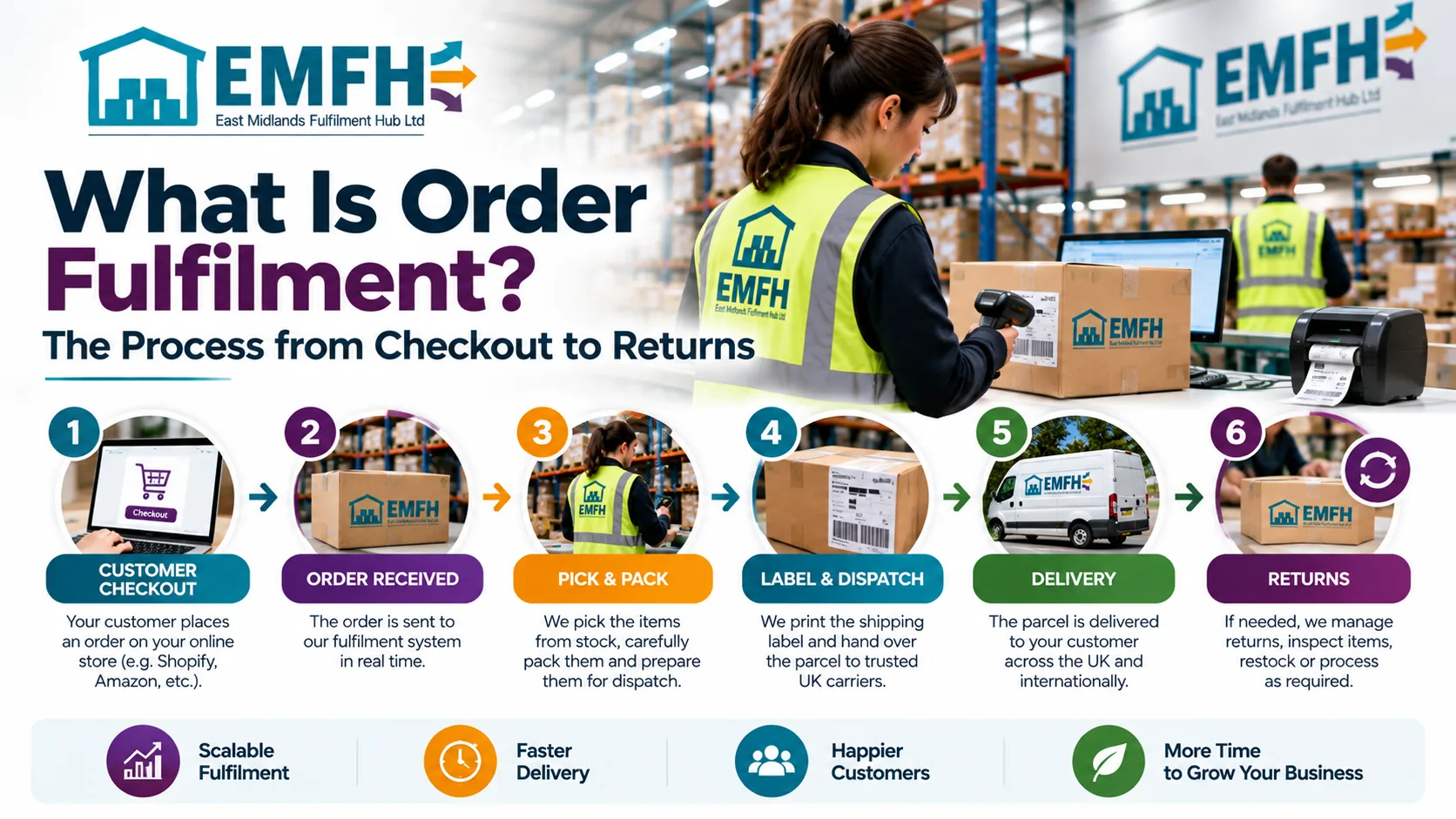
- Order tracking from pick through to courier collection
- Low-stock alerts — automated notifications before you run out
- Inbound and outbound movement reports — downloadable, accurate, up-to-date
Test the records against a receiving event, an order, a reservation and a return. A dashboard is useful when it describes the physical operation consistently. Retain a reconciliation process for failed updates and unexplained differences; system access does not remove the need for stock control.
5. Plan Peak Capacity Before the Campaign
Peak demand depends on your products, promotions and channels. Use your own history and a documented forecast range rather than assuming a standard multiplier. Include additional inbound receiving, packaging, assembly and returns work. An increase in order count does not describe the entire warehouse workload.
Agree capacity with the provider before the campaign. Share the timetable, expected order mix and changes to the forecast, and ask what can be supported. Your 3PL partner should explain the process for shortages, late arrivals and activity outside the agreed plan. Outsourcing is not an unlimited capacity guarantee.
Review how charges change when activity falls. Minimum fees, reserved capacity, contracts and retained internal expenses may continue. The quiet-period cost should be part of the same model as the peak-period cost. Check the agreed notice and stock-release terms before committing to the arrangement.
6. Test Your Actual Sales-Channel Integrations
An integration can connect store orders, warehouse processing, stock updates and dispatch information. Its behaviour depends on the provider, app and configuration. Check your actual workflow and the apps that affect it. A compatibility list is a starting point for a discussion, not evidence that every feature is supported.
Review EMFH’s platform integrations and ask the team to confirm your specific connection, product mappings and order types. Distinguish marketplace preparation and replenishment from direct customer dispatch. Test the proposed flow before switching live order routing.
Test order import, release rules, stock updates and dispatch confirmation using agreed samples. Include a cancellation after acceptance and an unavailable product. Shopify merchants can review Shopify’s official app fulfilment guidance alongside the provider’s instructions. A cancellation request should not be treated as a stopped shipment until its outcome is confirmed.
For shared stock across channels, agree reservations and availability calculations so one unit is not promised twice. Your 3PL partner and store team need an exception route for delayed updates and failed imports. Keep transaction references and reconciliation records; automation does not establish that manual checks are never needed.
7. Define Returns Inspection and Stock Decisions
Returns are the part of eCommerce that most brands manage reactively and inefficiently — a parcel arrives back, someone processes it when they get a chance and the stock may sit unprocessed for days or weeks before it’s back on sale.
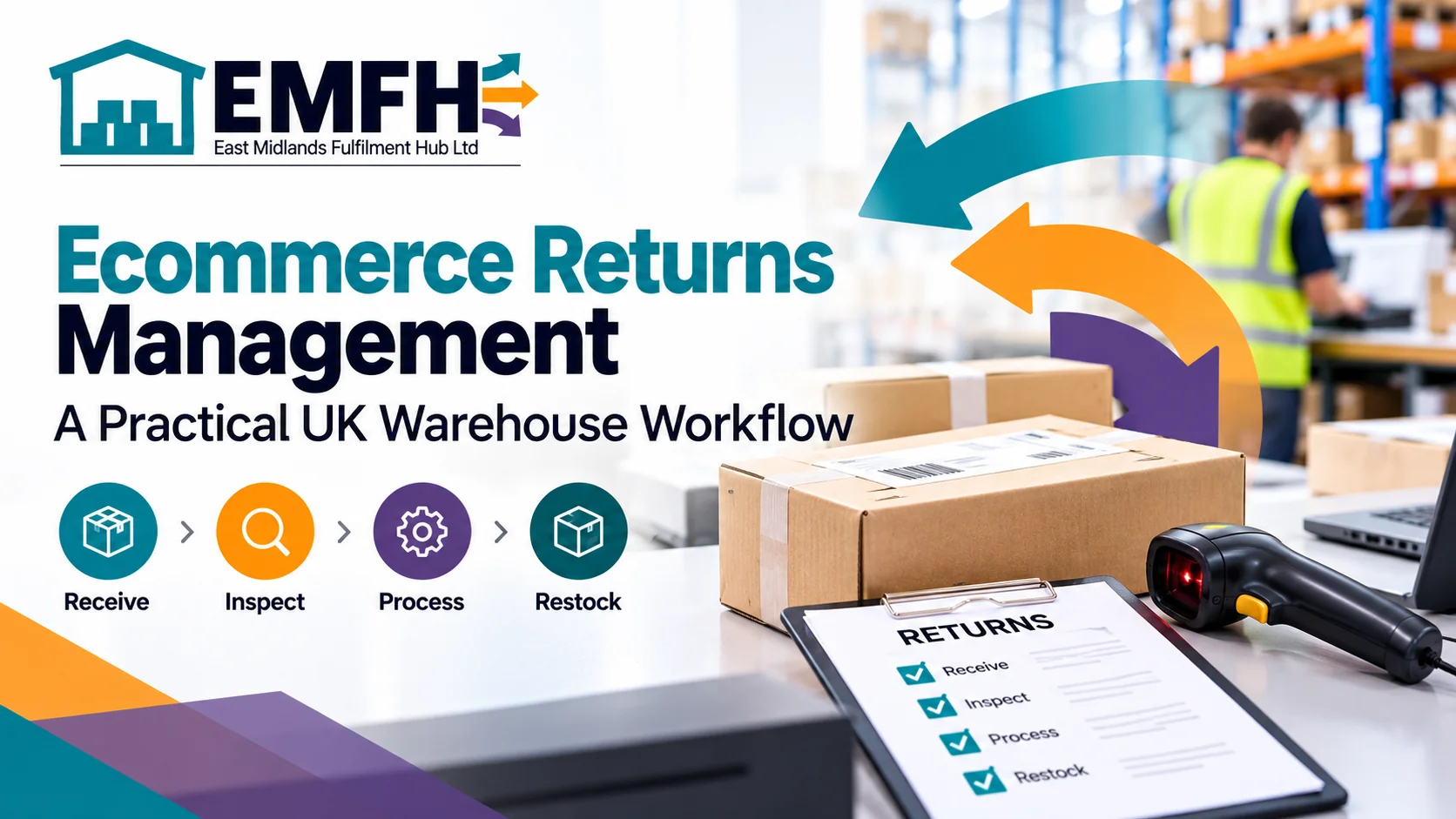
Agree returns receiving, identification, inspection and reporting with your provider. Separate a warehouse condition assessment from the customer refund decision. Define which products may become available again and which need approval, rework or quarantine. Confirm expected processing times against the actual product and workload.
Timely inspection can help recover suitable stock, but availability depends on an authorised condition decision. Incomplete, damaged or unidentified returns should remain in the appropriate hold status. Review the reasons for delay and the information your customer-service team needs to act.
8. You Free Up Management Time for Revenue-Generating Activity
Perhaps the most underestimated benefit of working with a 3PL is the management time it releases.
Every hour you or your team spend processing orders, dealing with courier queries, managing warehouse staff, chasing returns or reconciling inventory is an hour not spent on product development, marketing, customer acquisition or strategic growth.
Agree a named operational contact, absence cover, escalation route and the decisions each side can authorise. Ask how urgent changes are acknowledged and how recurring issues are reviewed. A 3PL partner should work from documented instructions, so the account does not depend on one person remembering an informal request.
At EMFH, every client gets a named account manager from day one. Not a ticket system. Not a call centre. A real person who picks up the phone.
Is a 3PL Right for Your Business?
There is no universal monthly order threshold at which outsourcing becomes the right choice. Product complexity, storage, staffing, minimum charges and retained costs all matter. Compare the full operating model and consider whether improving the current process could solve some of the same problems.
If you’re storing stock in a spare room, a self-storage unit or a rented warehouse you’ve outgrown; if you’re spending evenings and weekends packing orders; if your carrier rates are eating your margin; or if you simply want to scale without the overhead of building a warehouse operation — a 3PL is worth a serious look.
Give a 3PL partner a brief that can be priced and tested
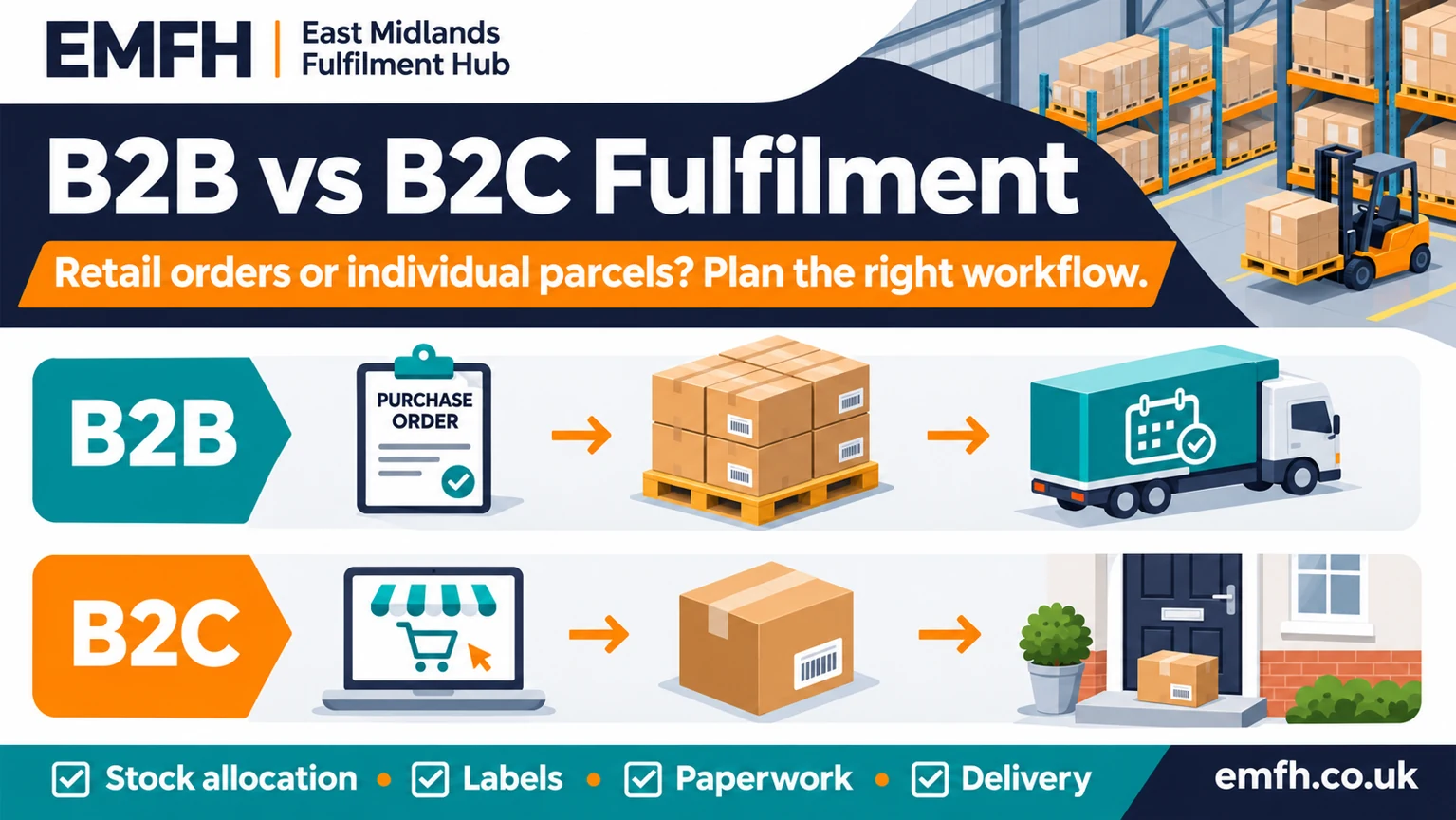
A useful brief describes the work you need and the evidence that will show it is being performed correctly. Start with a product file containing SKUs, variants, identifiers, dimensions and any handling restrictions. Add normal and peak stock levels, typical items per basket and your sales channels. Include the tasks outside ordinary dispatch, such as assembly, retailer labels, gift notes or returns inspection.
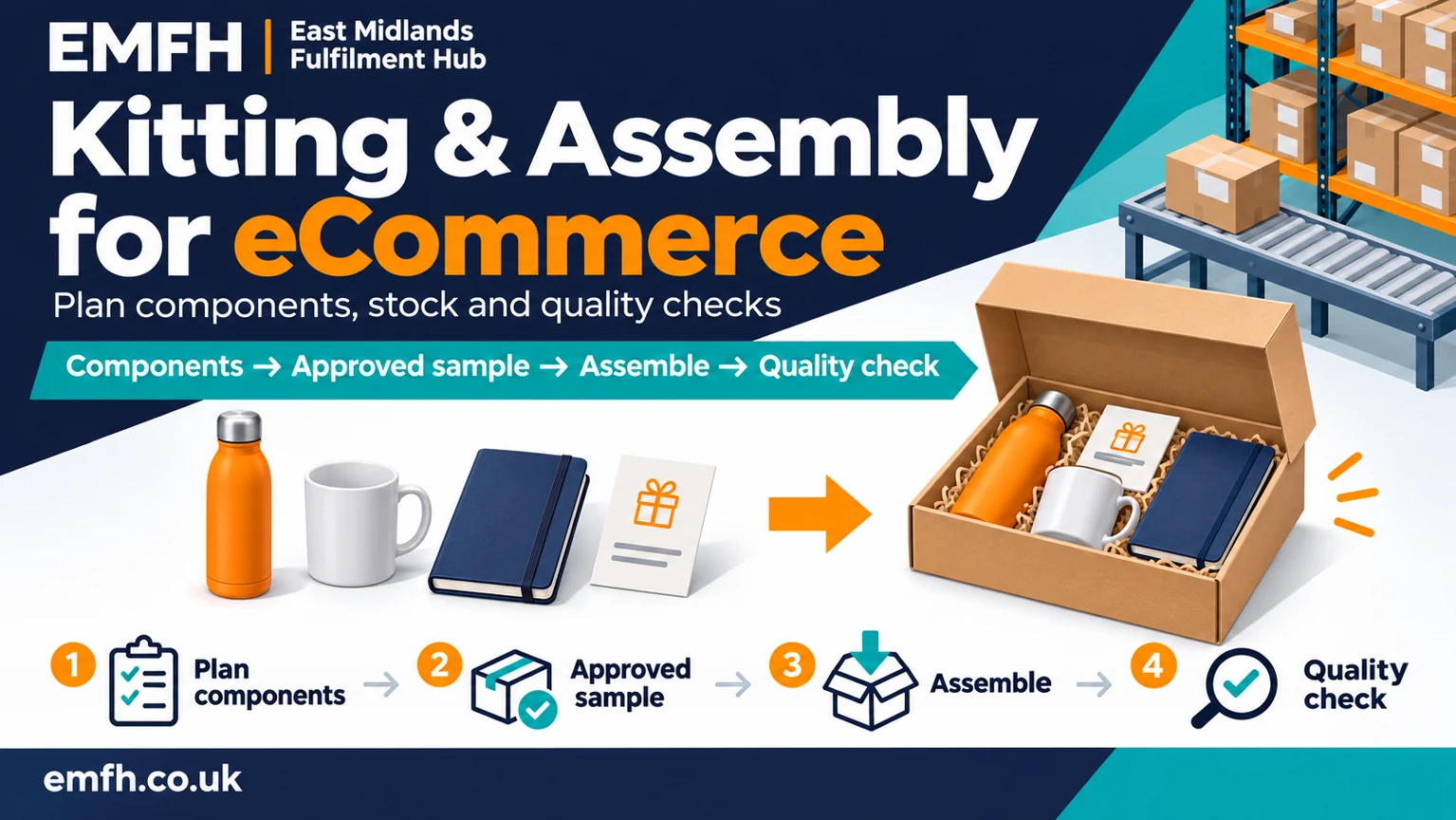
Separate requirements from preferences. If a product needs a specific control, confirm that capability before comparing minor reporting or presentation features. Give your 3PL partner current examples rather than only a verbal description. An approved packing sample, a representative trade order and a difficult return can expose questions that a general service list leaves unanswered.
Map responsibility before the first delivery
Record who supplies product data, who approves packaging, who creates replenishment instructions and who decides what happens to damaged stock. Your business normally retains commercial decisions even where a provider performs the physical handling. A missing approval should have a named owner and an escalation route, so an exception does not remain in a queue without anyone knowing what action is needed.
Use the same approach for changes. State the new instruction, the products and orders affected, its effective date and the evidence of approval. Ask how the warehouse acknowledges receipt and removes an obsolete instruction. A 3PL partner cannot apply two conflicting briefs consistently. Keep the approved version accessible to both teams and review it when a product or process changes.
Use representative test orders to approve the operation
Choose samples that reflect your actual workload. Include a normal single-item order, a multi-item basket, similar variants, a bundle and an unavailable product. Add a retailer delivery if your business supplies trade customers. Agree test arrangements so a sample cannot be mistaken for a genuine customer order, and check the entire result from import through stock movement and dispatch confirmation.
| Test | What to confirm with your 3PL partner | Result record |
|---|---|---|
| Product identification | Correct variant and unit of measure | SKU mapping and received order lines |
| Packing | Approved protection, materials and inserts | Sample approval and brief version |
| Cancellation | Request, acknowledgement and final shipment state | References and timestamps |
| Dispatch | Agreed carrier service and correct tracking update | Warehouse and store records |
| Return | Inspection and authorised stock outcome | Condition record and approval |
Record failures and repeat the affected case after correction. Do not approve a process merely because someone changed a setting or resent a message. Approval should be tied to the observed outcome. If an important case remains unresolved, state whether it prevents launch or restricts the initial scope. This helps both teams avoid different assumptions about what has actually been tested.
Review the relationship using agreed measures
Agree the definitions before comparing results. For dispatch, identify which orders were eligible, the required processing window and the evidence of handover. For stock, separate unexplained differences from known reservations and timing gaps. For returns, distinguish receiving, inspection, approval and restocking. Combining these stages into one measure can conceal the reason a task is waiting.
Ask your 3PL partner to review recurring exceptions with your team. A wrong item may arise from a mapping error, an unclear product identifier or a picking mistake; those causes need different corrections. Retain the order or SKU reference, issue, owner, action and outcome. Review whether the action solved the problem rather than treating every corrected order as the end of the investigation.
Turn a repeated issue into a process improvement
For example, suppose several orders are held because an insert instruction is unclear. Agree the products and order types that require the insert, the approved artwork and what happens when supplies run low. Update the brief, confirm receipt and test representative orders. Review the next affected orders to establish whether the change worked. This is an illustrative method, not a claim about a client result.
The value of a 3PL partner is easier to assess when the business can see what changed and why. Avoid relying on a headline error percentage without its definition or reporting period. Compare service outcomes, exception workload and total charges with the assumptions made when the account started. A different product mix or campaign can explain part of a change without excusing an unresolved process failure.
Check the first invoice against the agreed operating model
Use the first complete operating period to compare billed quantities with your records. Check receiving units, storage measurement, orders, additional items, packaging, preparation jobs, transport and returns where applicable. Confirm that any exceptional work has the approval required by your agreement. A lower or higher total alone does not show whether the operation matched the proposed scope.
When reviewing a 3PL partner invoice, separate a one-off launch job from recurring activity. Keep retained internal costs in your business comparison, including account oversight and any premises commitments that continue. Update the forecast using the actual order mix and stock holding. This gives the next review a realistic baseline rather than leaving the original quote assumptions unchanged indefinitely.
Keep records that support a future change
Retain the current product file, approved instructions, opening stock reconciliation and access to the operational reports your agreement provides. Review notice periods, release arrangements and the handling of unresolved stock discrepancies. A documented exit process does not imply that a relationship is failing; it gives both teams clarity about responsibilities if the scope changes later.
Your requirements may evolve as products, channels and volumes change. Discuss new work before assuming it fits the existing agreement. A 3PL partner can assess the capacity, handling and system implications of a new bundle or retailer. Clear scope, tested instructions and regular reviews help the relationship adapt without turning every change into an improvised exception.
Why East Midlands Fulfilment Hub?
EMFH is based at 133 Glaisdale Drive West, Bilborough, Nottingham, NG8 4GY. Use that location when assessing supplier and carrier routes. Confirm destination-specific services and pricing rather than assuming one delivery promise applies to every UK postcode.
Discuss receiving, storage, pick and pack, preparation and returns handling with EMFH. Confirm scope, pricing units, commitments, exclusions, dispatch arrangements and reporting in your written agreement.
To assess EMFH as a 3PL partner, contact the Nottingham team with your product list, order profile, stock holding, platforms and expected peaks. Include examples of unusual orders or preparation work so suitability can be discussed before stock is moved.
East Midlands Fulfilment Hub — 133 Glaisdale Drive West, Bilborough, Nottingham, NG8 4GY
T: 0115 646 1101 | E: 3pl@emfh.co.uk