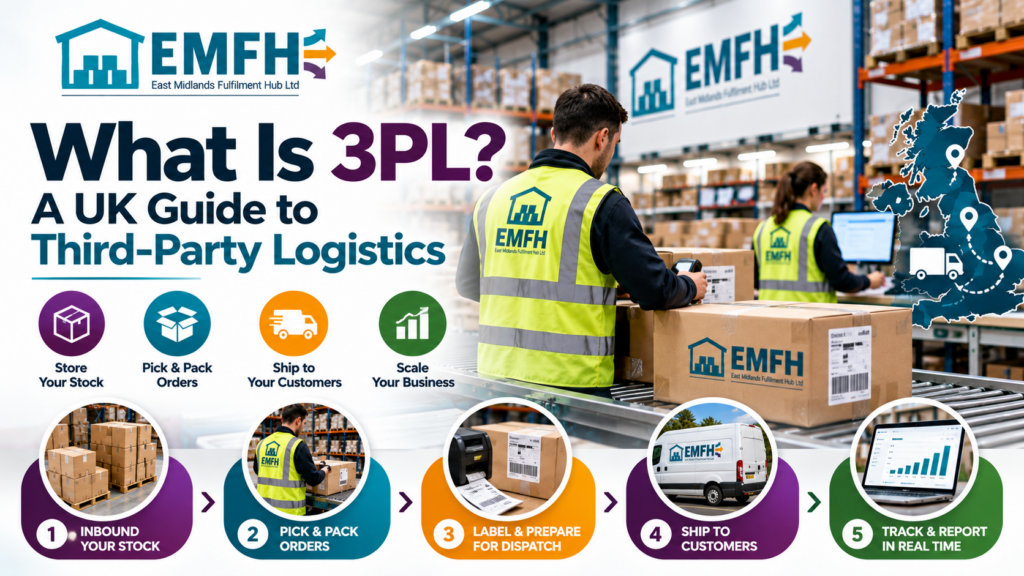
What is 3PL? 3PL means third-party logistics: using an external specialist to carry out agreed logistics activities for your business. In ecommerce, this commonly includes receiving products, storing stock, picking and packing orders, arranging dispatch and processing returned goods.
Third-party logistics creates an operational relationship. Your business still decides what to sell, what to promise customers and how to manage its commercial relationships. The provider handles the work specified in your agreement.
How does a third-party logistics relationship work?
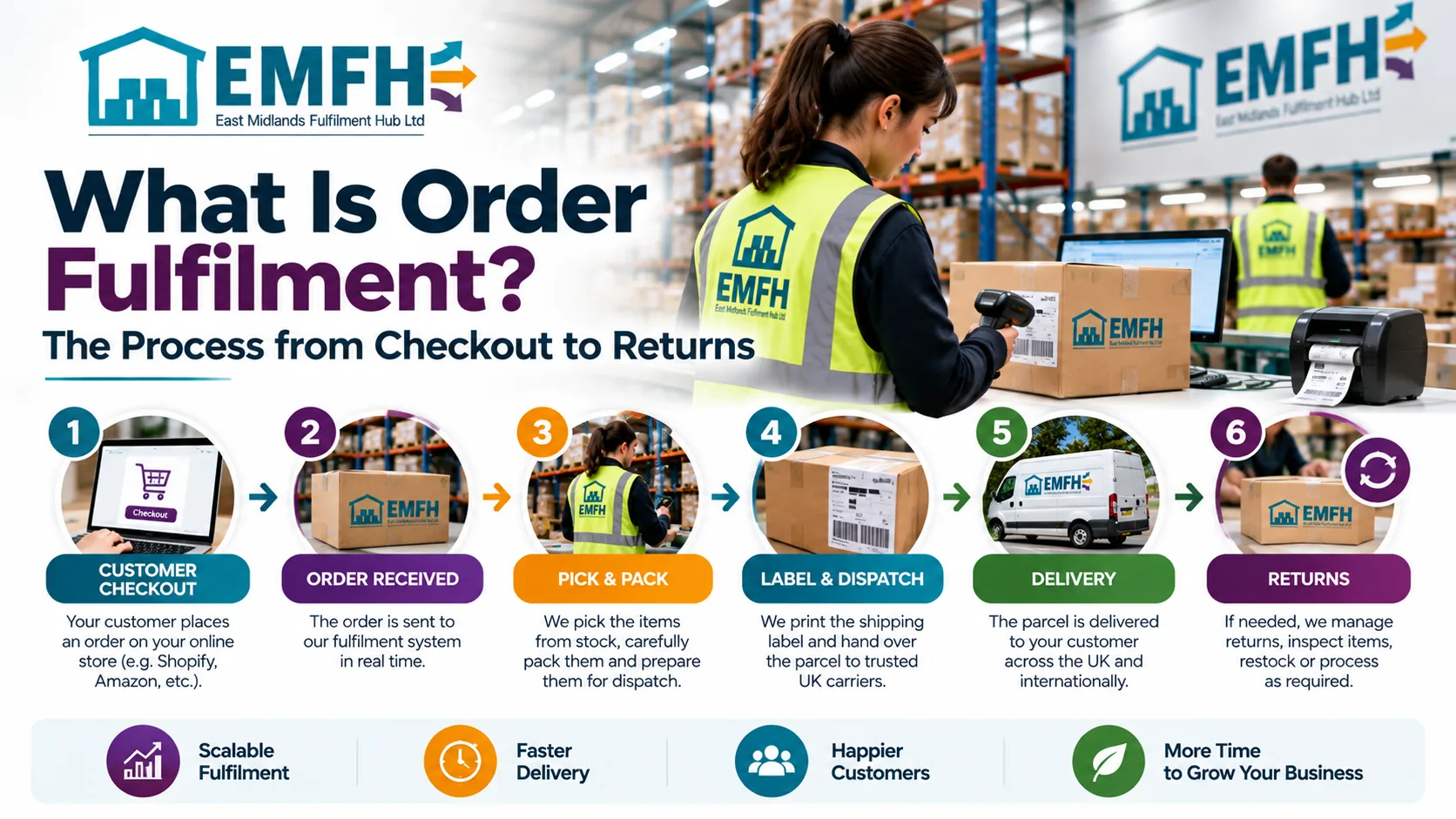
You send stock and product information to the provider. Your sales channels transfer eligible orders into its warehouse workflow. The team prepares those orders, hands shipments to carriers and shares the agreed inventory and dispatch information.
Before launch, both parties need to agree which system controls stock, how exceptions are handled, what services cost and which performance standards apply. The relationship works best when these decisions are written down rather than assumed.
Which services can third-party logistics include?
- Receiving: checking supplier deliveries and recording stock.
- Warehousing: storing products and maintaining location records.
- Order fulfilment: picking items and packing customer shipments.
- Carrier coordination: preparing labels and arranging collections.
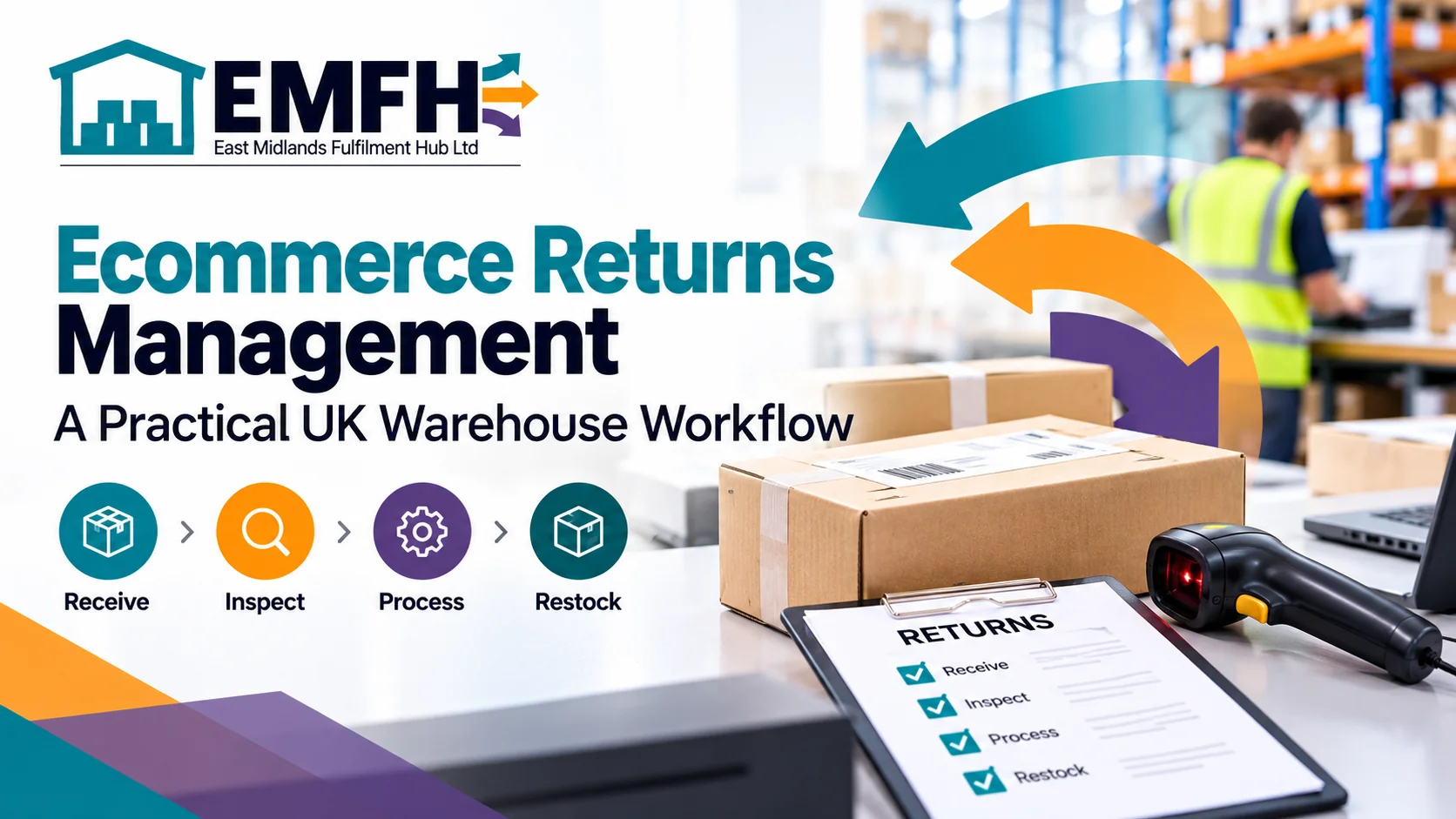
- Returns handling: recording, inspecting and sorting returned products.
- Additional preparation: agreed kitting, labelling or marketplace preparation.
Not every provider offers every service. Product restrictions, systems and handling capabilities differ. Review the actual scope for your stock rather than treating “3PL” as a standard package.
Third-party logistics versus a courier: who does what?
A courier transports shipments through its delivery network. A fulfilment-focused 3PL prepares the orders before that transport stage and can manage the stock around them. One business may coordinate several carriers, but dispatch performance and carrier delivery performance remain separate measures.
For example, the 3PL might pick and pack a customer’s order correctly and hand it over on time. A later failed delivery still needs an agreed escalation route. Decide who investigates, who updates the customer and who authorises the remedy.
When can outsourcing help?
It can make sense when order preparation takes time away from product development and sales, storage is becoming a constraint, or busy weeks repeatedly exceed your team’s capacity. A partner may also help when multiple channels and returns create coordination work that your current setup cannot manage reliably.
There is no universal order threshold. A small business selling bulky or complex products can need specialist support earlier than a higher-volume business with simple, uniform parcels. Compare workload and total cost, not just parcel count.
What are the trade-offs?
Outsourcing adds provider fees and a dependence on another team’s systems and processes. You may lose the ability to change packing instructions informally at the last minute. Stock transfers, setup work and integration testing also require planning.
In exchange, you can access an established warehouse operation without building every part yourself. Whether that improves the economics depends on your product profile, service requirements, volumes and the agreement. Savings should be calculated, rather than assumed.
What should remain under your control?
Keep ownership of product data quality, sales promises, replenishment decisions and customer policies. The warehouse cannot fulfil unavailable stock or infer an unrecorded change to a product bundle.
Nominate one contact for operational decisions and a backup. Agree how urgent changes are acknowledged, which reports you review and how you approve work outside the standard scope. Small gaps in responsibility can create expensive delays.
Questions to ask a potential 3PL
- Which product types and order profiles suit your operation?
- How are goods-in differences and stock discrepancies reported?
- What order cut-off, collection and exception rules apply?
- Which integrations are supported for my exact sales setup?
- How are returns inspected and recorded?
- What minimums, additional charges and exit terms apply?
Frequently asked questions
Is 3PL the same as fulfilment?
Fulfilment is a set of activities. A 3PL is an external provider that may perform those activities, alongside other logistics services. You can also manage fulfilment in-house.
Can a 3PL support multiple sales channels?
Many can, but confirm the specific integrations, order-routing rules and stock updates for each channel before committing.
Will outsourcing remove all operational work?
No. You still need to plan stock, maintain product data, manage customers and review provider performance.
Third-party logistics is an agreed operation, not a standard bundle
The term describes who performs logistics work, rather than a fixed list of services every provider must offer. A fulfilment-focused operation may receive products, hold stock, prepare customer orders and manage returns. Another provider may have a different scope. Start by identifying the work your business needs, then ask which activities, products and systems the proposed agreement actually covers.
For a third-party logistics brief, record your product range, dimensions, order profile, sales channels and stock holding. Add any assembly, retailer labels, expiry controls or specialist handling requirements. A general service name does not establish suitability for those details. Obtain confirmation before moving inventory, and keep exclusions with the approved scope so both teams understand the limits.
Receiving and stock records
Receiving connects a supplier delivery with an inventory record. The team needs identifiers, expected quantities and the agreed checks. Differences should be recorded rather than absorbed into an unexplained opening balance. Third-party logistics does not remove the need for accurate supplier information; the provider can only compare a delivery with the instructions and evidence available.
Agree when a received unit becomes available for orders. Products may be physically present while awaiting inspection, preparation or a decision about damage. Define available, reserved, quarantined and in-transit statuses where relevant. A useful stock record explains both the quantity and its permitted use. Your business needs to understand those meanings when setting availability across channels.
Order handling and carrier transport
Order fulfilment is the physical and system workflow that turns an eligible order into a prepared shipment. Transport begins with the agreed carrier handover and continues through the delivery network. Third-party logistics can coordinate these stages, but warehouse dispatch and carrier delivery remain different events. A label or dispatch message alone does not establish that the recipient has received the parcel.
State the working-day cut-off and eligibility rules in the service brief. Check how payment holds, invalid addresses, unavailable stock and preparation work affect release. Ask what records are available when a parcel needs investigation. The commercial promise your business makes should match the agreed operation and selected carrier service, including relevant destination and peak-period conditions.
A third-party logistics responsibility matrix
A responsibility matrix identifies who provides information, performs the task and approves an exception. It is useful even for a small account. A missing decision can leave goods waiting without an owner, while conflicting instructions can create rework. Keep one current version of the brief and identify a backup contact for important approvals.
| Activity | Business responsibility to agree | Provider responsibility to agree |
|---|---|---|
| Product setup | Accurate identifiers, specifications and restrictions | Mapping, storage and handling configuration |
| Receiving | Advance information and discrepancy decisions | Agreed checks and receiving records |
| Order release | Customer promise and approval rules | Processing eligible instructions |
| Packaging | Approved standard and substitutions | Packing to the agreed brief |
| Returns | Customer policy and authorised stock outcomes | Receipt, inspection and reporting within scope |
| Exceptions | Named decision owner and timely response | Notification, evidence and escalation |
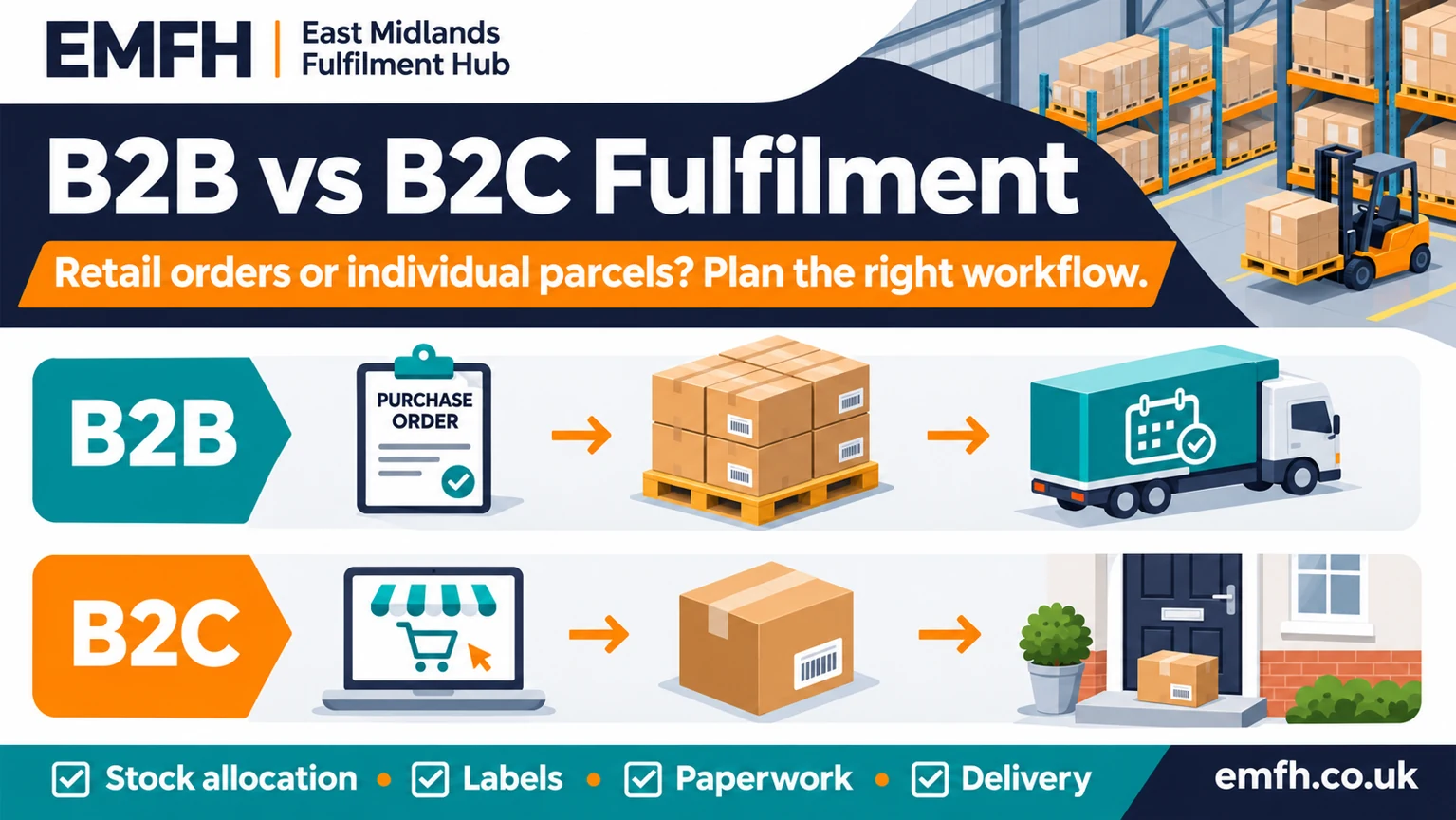
The matrix should reflect your third-party logistics agreement rather than assign every activity automatically. For example, the party creating marketplace shipment instructions may differ between accounts. Agree that responsibility explicitly. Also identify which system is authoritative for products, stock and order changes, so teams do not resolve a disagreement by applying conflicting adjustments.
A worked stock example in third-party logistics
This is an illustrative example, not an EMFH client result. A supplier sends 500 units of a product. Receiving records 490 acceptable units and 10 damaged units held for a decision. The physical receipt can account for all 500 while the available quantity remains 490. Recording the full delivery as saleable would hide the condition difference.
Next, the business reserves 40 acceptable units for a trade order. If the agreed system treats that reservation separately, only 450 units remain available for other demand. A ten-unit consumer order is then dispatched, leaving 440 available, 40 reserved and 10 held. The records should explain the total through receiving, allocation and outbound movement.
The third-party logistics process needs a reference for each change, not just a final total. If a returned unit arrives, it should follow the agreed inspection and approval route before increasing available stock. If a reserved delivery is cancelled, the reservation needs an authorised release. These events are different from receiving new supplier stock and should remain traceable.
Use a similar example when reviewing a provider’s demonstration. Ask how the system records the receipt, damaged units, reservation, dispatch and return. Confirm which updates reach your store and what happens if an update fails. Third-party logistics visibility is valuable when the records consistently describe the physical operation and its decisions.
What third-party logistics onboarding involves
Onboarding normally requires a product file, operating brief, pricing scope, integration configuration and opening stock reconciliation. The exact sequence depends on the provider and your requirements. Agree the acceptance conditions before setting a live date. A proposed connection or packing method should be distinguished from one that has passed the agreed test.
Use sample orders covering your actual workload: a single item, several variants, a bundle, a cancellation and unavailable stock. Include a trade delivery or return if those services are in scope. Keep the expected and actual outcomes, and repeat failed cases after correction. A third-party logistics launch should be approved against observed results rather than an assumption that routine orders will be easy.
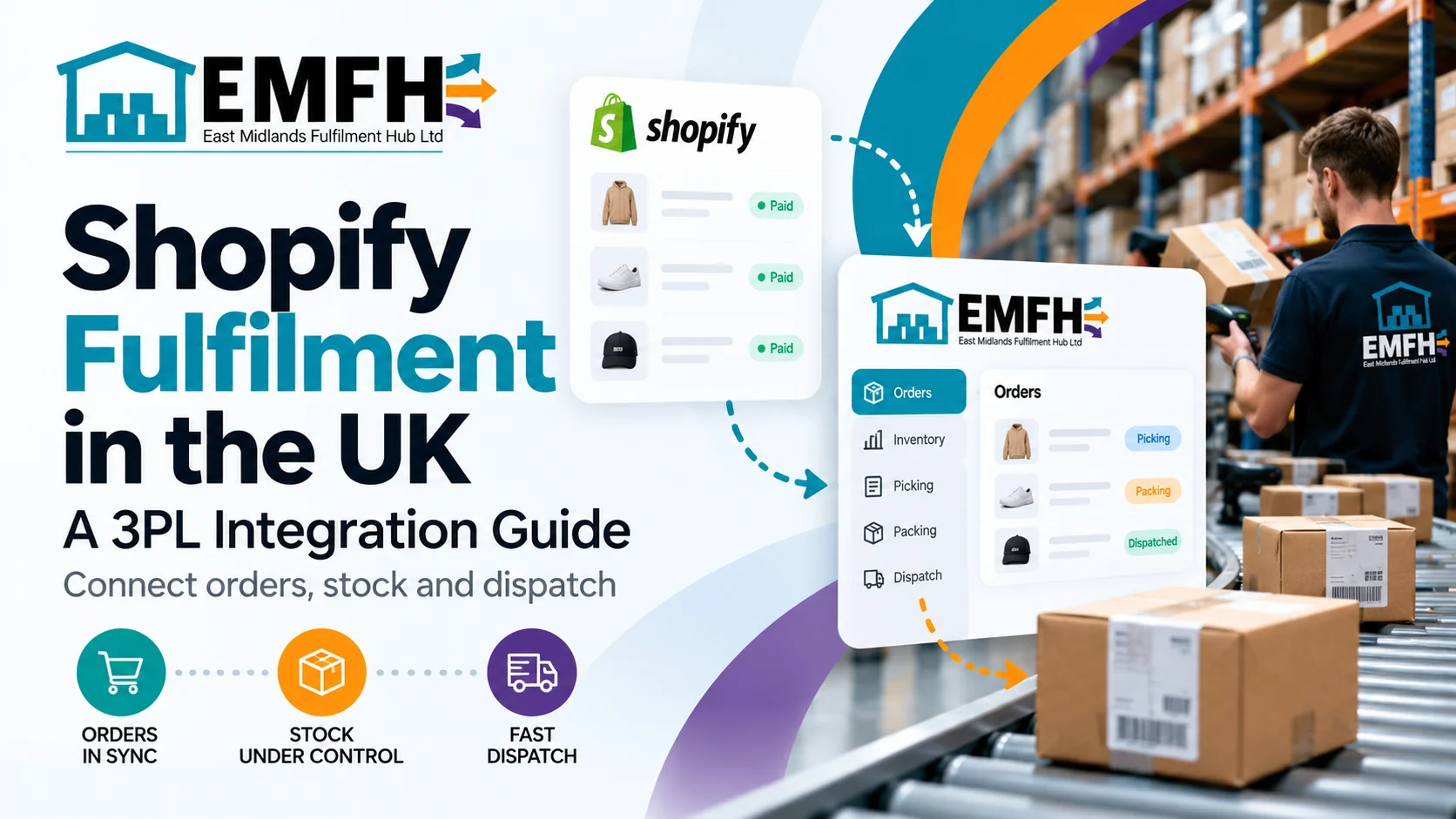
If Shopify is involved, review Shopify’s official app fulfilment guidance alongside the provider’s instructions. Confirm the actual app and account configuration. In particular, a cancellation request after acceptance needs a known response and final outcome; changing a store status should not be mistaken for confirmation that a physical shipment has stopped.
Plan a controlled stock transfer
Identify the last orders handled through the old route and the first handled through the new route. Decide how orders already in progress will complete. Record stock in transit and reconcile the receiving result before relying on the opening available balance. Third-party logistics transitions work better when order ownership and stock location remain clear throughout the handover.
Agree a fallback for a failed critical check. It could involve postponing the switch or limiting the first live scope while a problem is corrected. Confirm the supported controls with the store administrator and warehouse. Keep a record of temporary manual actions, then reconcile and remove them through a controlled review once the normal workflow is working.
The third-party logistics exceptions worth planning first
Start with the situations likely to interrupt your operation: a delivery arriving without advance information, an unknown SKU, short stock, a damaged item, a changed address and an incomplete return. For each, identify the evidence needed, the person who can decide and the status used while waiting. The aim is to turn an unexpected event into a known workflow.
A third-party logistics exception log can be simple: reference, issue, owner, next action and outcome. Review recurring reasons rather than only closing individual transactions. Several held orders may reveal a product-mapping problem or an unclear packing instruction. Correcting the underlying rule can be more useful than repeatedly fixing the symptoms manually.
Keep changes under control
When changing a bundle, packaging insert or retailer requirement, supply an approved version and effective date. State which products and orders are affected and how old instructions should be withdrawn. Ask the provider to acknowledge the change and test it where appropriate. Third-party logistics performance depends on current instructions as well as the team carrying out the work.
Do not assume a new sales channel or product automatically fits the existing arrangement. Give the provider enough information to assess handling, systems and capacity. Confirm any revised scope and charge before launch. Clear changes protect the business from presenting a new customer promise before the operation is ready to support it.
Review third-party logistics using the agreed definitions
Choose measures tied to the services you use: eligible orders dispatched within the agreed window, receiving discrepancies, unexplained stock differences, returns awaiting approval and recurring manual interventions. Define each measure and its reporting period. A headline percentage without a clear denominator may conceal the orders excluded or the stage actually being measured.
Compare actual activity and billed quantities with the original assumptions. More stock holding, larger baskets, extra assembly or a different destination mix can change the total without a rate change. Keep one-off launch work separate from recurring charges. Our fulfilment costs guide explains a quantity-and-rate approach to that review.
Review the third-party logistics relationship when a material assumption changes. The useful question is whether the agreed operation still fits your products, channels and customer promise. Retain product records, approved instructions and access to the reporting your agreement provides. A clear scope and review process helps both teams adapt without relying on undocumented workarounds.
Does third-party logistics include buying or manufacturing products?
Not automatically. Product sourcing, manufacturing and commercial purchasing are different activities from receiving, storage and order handling. A provider may offer additional services, but they need to be agreed explicitly. Keep the supplier relationship, product specification and approval responsibilities clear. Sending stock to a warehouse does not mean that the warehouse has verified every commercial or product decision made before it arrived.
Does third-party logistics replace customer service?
Only the customer-service activities included in the actual agreement are covered. A warehouse may provide inspection or shipment information while your team decides the customer response and refund. Agree the information shared, access arrangements and decision authority. If a parcel is delayed, both sides should know who investigates, who communicates with the customer and who can approve a remedy.
Can third-party logistics work with stock kept elsewhere?
A hybrid model can work where the locations, allocations and routing rules are supported. Identify which products are available at each location and which route owns a mixed order. Test split shipments, reservations and changes. The customer should understand any multiple-parcel arrangement, and the business should retain a reconciliation process for transfers and stock differences.
For a first discussion, take a small set of representative examples rather than trying to predict every possible exception. Explain a routine order, a difficult product, a peak period and a return needing approval. Ask how the proposed third-party logistics operation would handle each one. Use the answers to identify the data, tests and scope decisions needed before launch.
Discuss third-party logistics with EMFH
East Midlands Fulfilment Hub provides fulfilment services from Nottingham. Review our service range, explore pick and pack fulfilment or request a discussion about your operation. If you are starting with the basics, read our order fulfilment process guide.