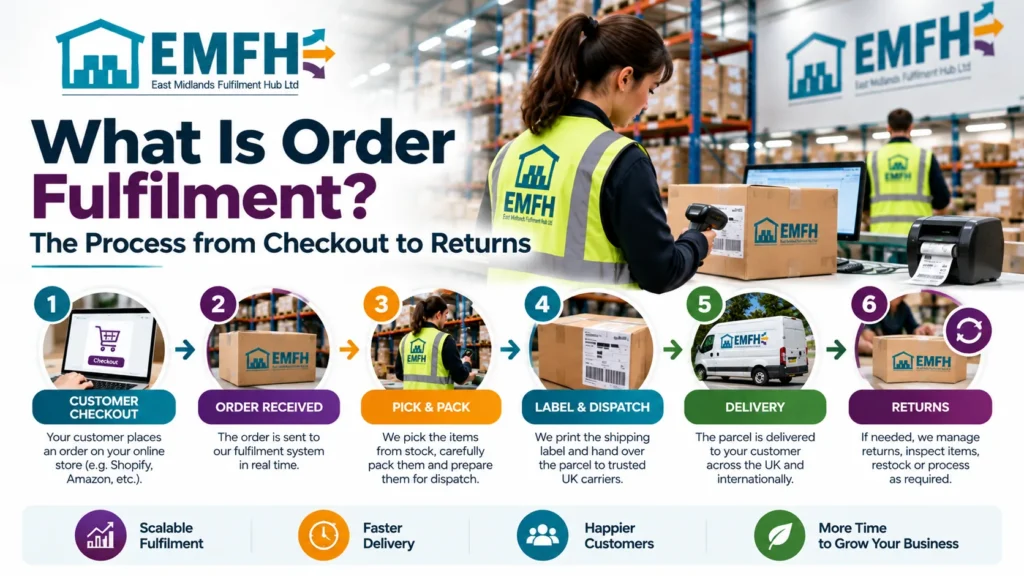
Order fulfilment is the process of turning a confirmed customer order into a correctly prepared and delivered shipment. It connects your sales system, inventory records, warehouse team and carrier, with a returns process for products that come back.
Understanding the individual stages makes it easier to find delays and prevent mistakes. This guide follows a typical physical product order and explains the checks a UK ecommerce business should build into its operation.
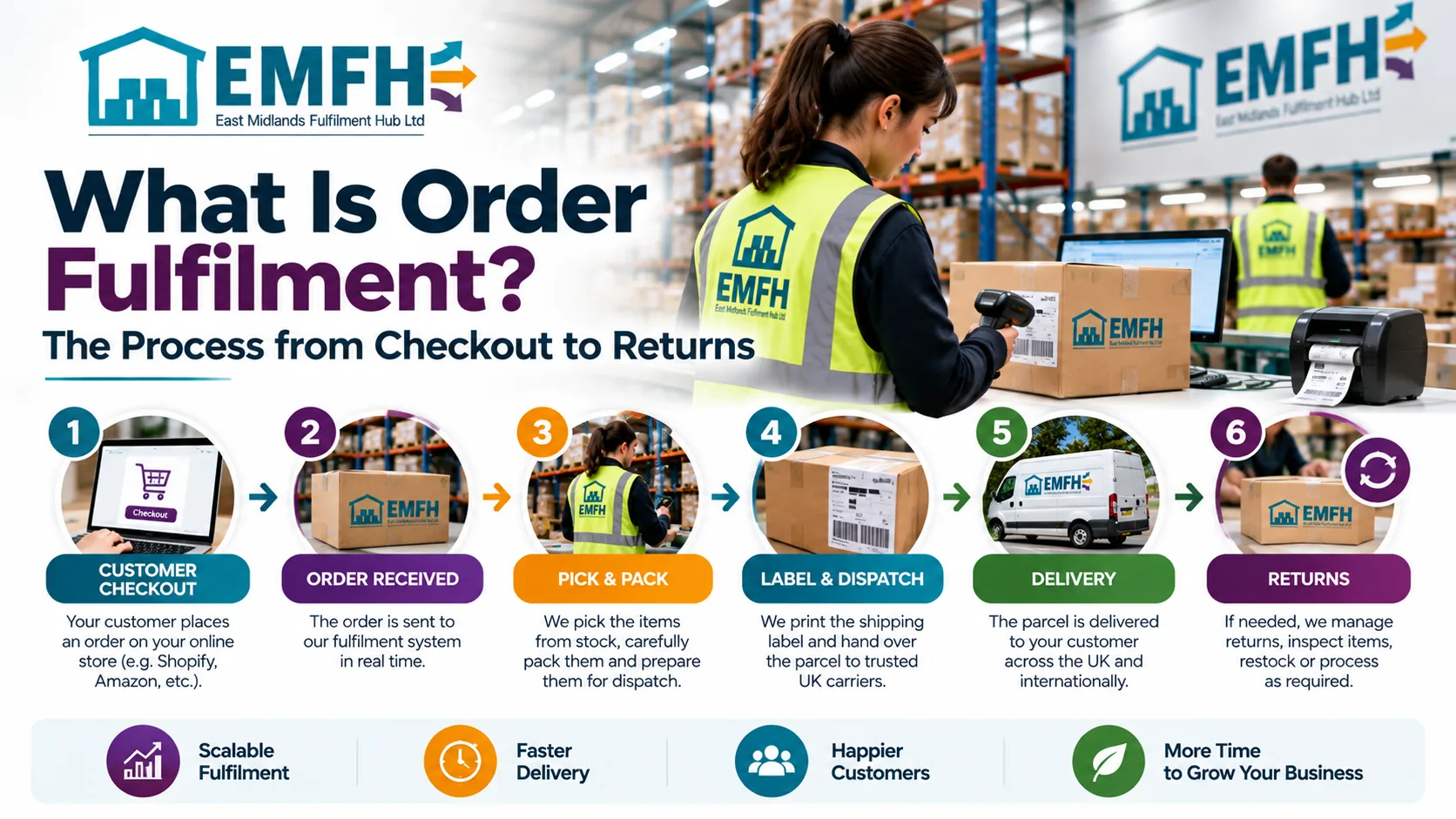
1. Receive stock and establish an accurate starting point
Fulfilment starts before a customer buys. When a supplier delivery arrives, reconcile it with the expected SKUs and quantities. Record shortages, damage and unexpected products separately. A delivery note is evidence of what was sent, rather than proof of what your warehouse actually received.
Give every product variant its own consistent identifier. Where relevant, agree batch, expiry and serial-number recording before goods arrive. Inaccurate goods-in records create picking problems later, even when the packing team follows every instruction.
2. Store products in traceable locations
Put products away against a recorded bin, shelf or pallet location. Separate saleable stock from quarantine and returned items. The stock available for sale should reflect what can actually be shipped, rather than including damaged or reserved units.
A regular cycle-count routine helps catch differences between system records and physical quantities. Investigate the reason for discrepancies instead of simply changing the number.
3. Validate and release the customer order
The warehouse needs a clear signal that an order is ready. Depending on your setup, this can follow payment confirmation, fraud review and stock allocation. Holds must be visible so staff do not send an order that needs a customer decision.
Check address quality, shipping method and any product restrictions before release. Define what happens when only part of an order is available: hold everything, send a partial shipment, or contact the customer. An agreed rule prevents different staff making different promises.
4. Pick and check the correct products
A picking task identifies the product, location and required quantity. Checks should distinguish similar variants, such as two sizes of the same design. Barcode scanning can support this, provided product and location data are reliable.
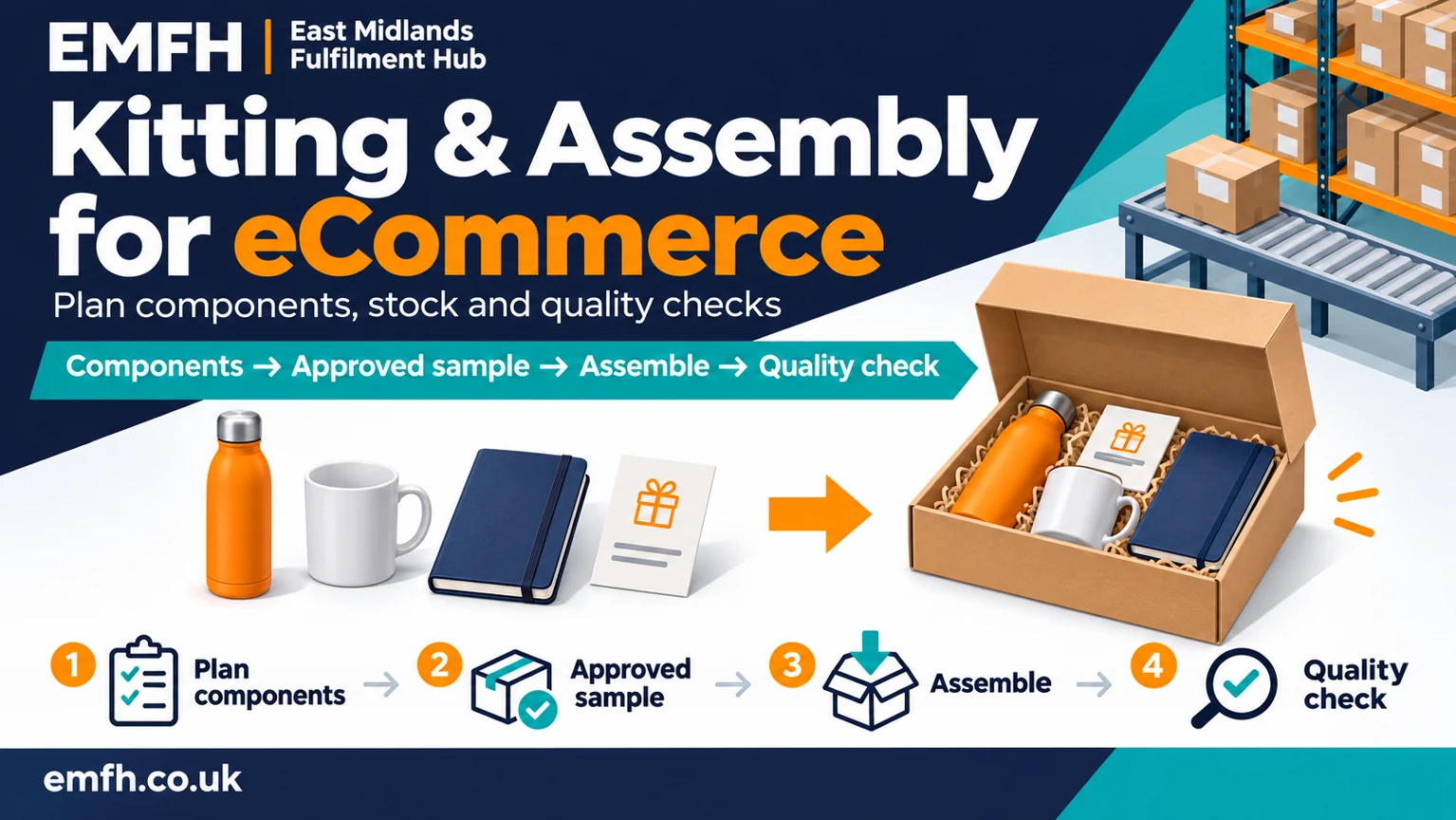
For a bundle, specify whether the warehouse picks an already assembled unit or collects several components. The order cannot be treated as complete until all required parts are accounted for. EMFH’s pick and pack fulfilment page explains this part of the service.
5. Pack to protect the product and match the service
Choose packaging around the product’s fragility, shape and journey. Excess empty space can allow movement, while unnecessarily large parcels can increase shipping costs. Record a repeatable packing specification for products that need extra protection.
Confirm the contents before sealing and apply the right shipping label to the right parcel. Branded inserts, gift notes and retailer paperwork need explicit instructions and stock control of their own.
6. Dispatch and update the sales channel
A printed label is not the same as carrier handover. Agree how the operation records collection and how exceptions are escalated if a parcel misses its expected departure.
Return tracking details and fulfilment status to your store through the agreed integration. Keep customer wording precise: dispatch and delivery are different milestones, and delivery estimates depend on the selected service.
7. Close the loop with returns
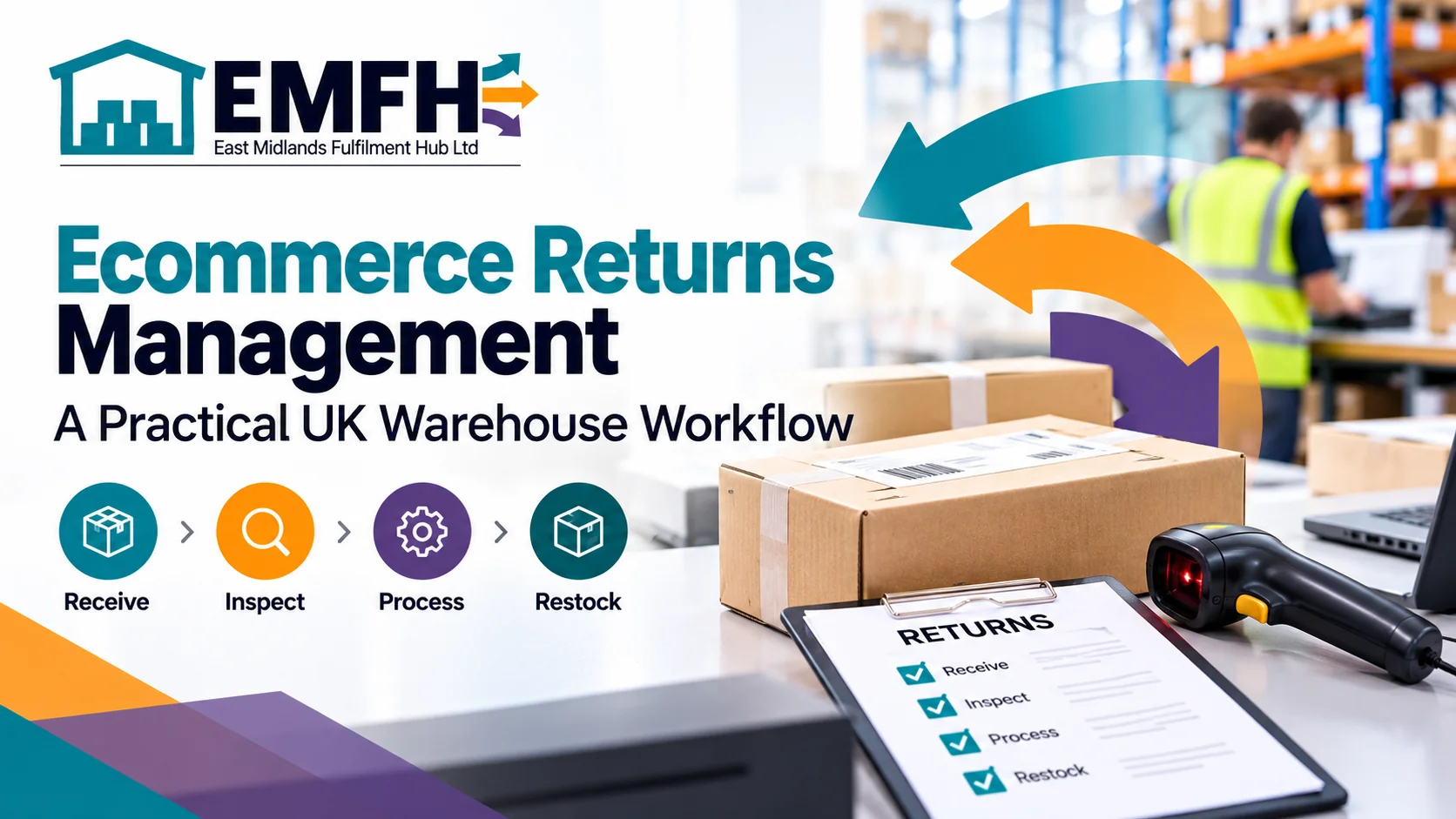
Match returned products to the original order, record the reason and inspect their condition. Only approved stock should return to saleable inventory. Refund decisions, resale rules and disposal authorisation need named owners.
Our returns management service supports the warehouse side of this workflow. Use return reasons to identify recurring sizing, description, damage or picking problems.
What should you measure?
- Time from eligible order receipt to dispatch.
- Correct items and quantities per order.
- Orders waiting on an exception and how long they have waited.
- Differences between physical and recorded stock.
- Time from return receipt to inspection outcome.
Frequently asked questions
Does fulfilled mean delivered?
Not necessarily. A store may use fulfilled when warehouse work is complete or shipment details are recorded. Carrier tracking provides the delivery milestone; define your status wording clearly.
Who handles a failed delivery?
Agree which team contacts the carrier, updates the customer and decides on replacement or refund. A fulfilment contract should make those responsibilities clear.
Can the process be outsourced?
Yes. A fulfilment partner can run agreed warehouse stages while your business controls the customer offer and product decisions.
Order fulfilment statuses need a shared meaning
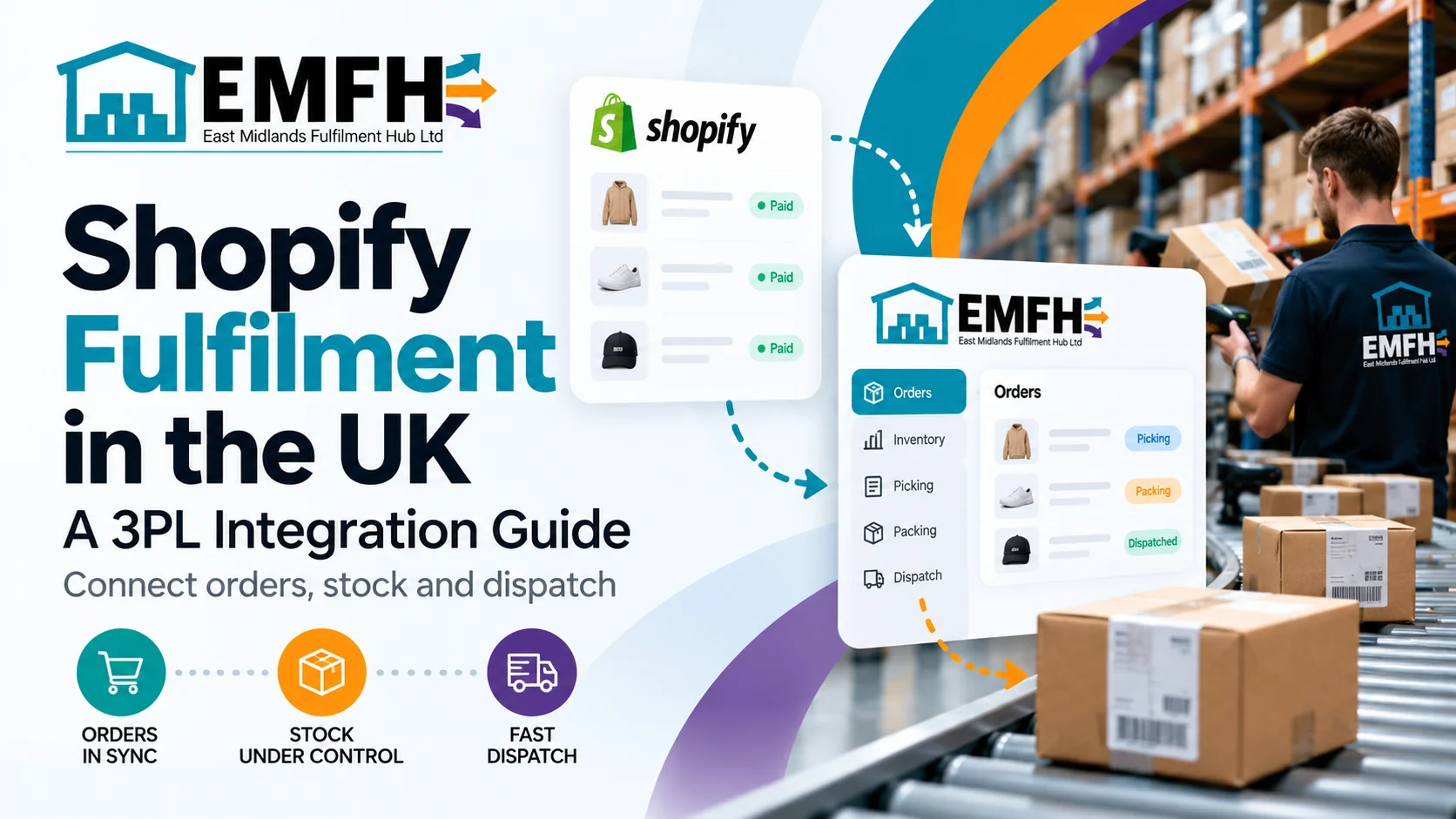
A status is useful only when the store, warehouse and customer-service team understand the event behind it. An order can be paid but held, released but not picked, packed but not collected, or dispatched but not delivered. Document the stages your actual systems use and identify which updates are automatic and which need an authorised decision.
In an order fulfilment brief, distinguish a request from its outcome. A cancellation request is not the same as a confirmed cancellation, and a stock-transfer instruction is not a receiving confirmation. Keep the source reference and timestamp where available. This makes it easier to investigate a transaction without relying on a vague label such as “processed”.
| Stage | What it should establish | What it does not establish |
|---|---|---|
| Accepted | The order exists in the relevant system | It is eligible for warehouse release |
| Released | Agreed holds have been cleared | The products have been picked |
| Packed | The physical order has been prepared under the agreed checks | The carrier has collected it |
| Dispatched | The defined warehouse handover event is recorded | The recipient has received the parcel |
| Delivered | The carrier records the relevant delivery outcome | A later customer issue or return cannot occur |
| Return received | The returned parcel has entered the receiving process | All contents are approved for resale |
These are example definitions for planning, not a claim that every platform uses identical status names. Confirm the mapping for your own order fulfilment systems. For Shopify, review the official app fulfilment guidance with the actual app and provider. Test accepted requests, cancellations and final updates rather than assuming a store change automatically stops warehouse work.
Keep a traceable record through each handover
Connect the customer order reference with the warehouse job and shipment record. Product identifiers, quantities, packing instructions and the selected service should remain consistent. If a job is recreated manually, retain the link to the original reference and the reason. Otherwise a recovery action can create a duplicate that looks like a separate valid order.
For order fulfilment involving several parcels, record which contents and tracking reference belong to each parcel. A single status for the whole basket may not describe a partial shipment. Agree the customer message and stock treatment when one item is held or sent separately. Keep the commercial decision visible instead of leaving warehouse staff to infer it.
A worked order timeline
This is an illustrative example, not an account service commitment. A customer orders two units of product A and one unit of product B. The order reaches the store but remains on an address hold. No warehouse release should occur until the agreed owner resolves that hold. The checkout time and the release time are therefore different events.
After approval, the order enters picking. Staff identify two acceptable A units, but the available B unit is damaged. The order fulfilment rule determines whether the basket is held, partially shipped or sent for a customer decision. Record the affected unit and the approval rather than silently substituting another product or marking the whole order complete.
Suppose the business approves a partial shipment of the two A units. The packing record, stock movement and customer notification should describe that partial outcome. Product B remains unresolved until a separate authorised decision. A carrier collection for the A parcel does not establish that all three ordered units have been delivered.
Use a similar timeline in testing. Check what each team sees when the hold is added, released, partially fulfilled and closed. Good order fulfilment records preserve the sequence and the reason for a decision. They make it possible to explain what happened without reconstructing the event from several unrelated messages.
An order fulfilment exception matrix
Agree the common exceptions before launch. For each, record the permitted action, decision owner, evidence needed and status while waiting. Keep actions within the scope each team can authorise. An urgent parcel does not justify bypassing a payment hold, product restriction or unresolved stock issue without the agreed approval.
| Exception | Check before acting | Decision to agree |
|---|---|---|
| Missing SKU mapping | Product and variant identity | Who approves the correct mapping |
| Short stock | Locations, reservations and movement history | Hold, partial shipment or another authorised outcome |
| Address change | Whether physical processing has begun | How a change is requested and confirmed |
| Cancellation request | Accepted request and current shipment state | Who confirms the final result |
| Packaging shortage | Approved alternatives and product protection | Who can authorise substitution |
| Missed collection | Prepared parcels and carrier handover evidence | Alternative service and customer update |
| Unidentified return | References, contents and condition | Investigation and stock status |
Review the age and cause of unresolved order fulfilment exceptions. A queue with no named owner can hide stock awaiting approval or a customer response. Assign a next action and revisit recurring reasons. Repeatedly correcting a missing identifier manually is less useful than fixing the product data or mapping rule that creates the issue.
Measure order fulfilment with a defined denominator
Start by defining the transactions included in a measure. For dispatch performance, identify eligible released orders and the agreed processing window. Keep orders legitimately on hold visible in a separate measure. Otherwise the business can neither assess the warehouse commitment fairly nor understand why customers are still waiting for particular orders.
For accuracy, state whether the measure concerns orders, lines, units or parcels and what counts as an error. A correct product in the wrong quantity and a correct parcel with the wrong label are different failure modes. Keep the definition and period with the result. Avoid comparing percentages from different definitions as though they describe the same operation.
A simple reporting example
Suppose 120 orders are received in a review period, with 10 held under the agreed eligibility rules. Of the remaining 110 eligible orders, 108 meet the dispatch commitment and two do not. Report the eligible-order result as 108 out of 110, while showing the 10 held orders and their reasons separately. This is an illustrative calculation, not an EMFH performance claim.
The order fulfilment report should also explain the two missed commitments and who owns the corrective action. A single percentage cannot show whether the cause was short stock, missing information, warehouse processing or a collection issue. Keep the supporting references and investigate the cause before deciding which process needs to change.
Test the whole order fulfilment route before launch
Use agreed sample transactions covering a standard order, similar variants, a bundle, an unavailable item, an address change, a cancellation and a return. Define the expected system updates and physical outcomes. Use test arrangements that cannot be mistaken for live customer shipments, and repeat failed cases after the correction.
Include the handovers between teams, not only the warehouse task. Confirm who supplies product data, approves packing, clears holds, investigates delivery issues and authorises a returned item’s stock outcome. An order fulfilment launch is ready when the agreed scope has passed its checks and unresolved conditions have an explicit decision.
Keep changes controlled after launch
When introducing a new bundle, insert, carrier service or channel, update the relevant specification. Identify the effective date and affected orders, obtain acknowledgement and test the change where appropriate. Retain the previous version so a later question can be traced to the instruction used at the time. Informal changes can otherwise create different rules across teams.
Review product and order profiles as well as performance. A new promotion may increase units per basket without increasing order count, while a new retailer can add labelling and booking work. Give the provider enough information to assess the change before promising it to customers. Keep the cost and capacity assumptions consistent with the operation being run.
A five-step triage for an order that appears stuck
- Identify the transaction: retain the store, warehouse and shipment references, including any manually recreated job.
- Confirm the current stage: check the actual hold, physical preparation and handover records before changing a status.
- Assign the decision: identify who can approve an amendment, partial shipment, cancellation or alternative service.
- Record and reconcile the action: link the instruction, response, stock movement and customer update.
- Review the cause: correct a recurring mapping or instruction problem and test the revised workflow.
Begin with observation rather than immediately resending an order. A missing acknowledgement does not prove the warehouse never received the instruction. If a replacement job is created before checking the physical stage, both jobs may look eligible for processing. Keep the original reference visible and confirm the final outcome of each affected transaction.
For an order fulfilment incident, agree who can authorise temporary manual processing and which orders it covers. A workaround should have a clear scope and an end condition. Once the normal route recovers, reconcile the affected orders and stock movements before removing the temporary process. Do not assume that clearing an error message proves the physical operation is correct.
Keep customer communication aligned with confirmed events. If the warehouse is still investigating a hold, explain the known position rather than promising a dispatch time that has not been approved. If a parcel has been collected but not yet scanned in the carrier network, distinguish those records. Precise language helps customer service explain the situation without creating another conflicting promise.
Review the incident after resolution. Identify whether the root cause was product data, an integration rule, an operational instruction, physical handling or transport. Assign a corrective action and check whether it worked on a representative order. This turns the order fulfilment record into a tool for prevention as well as a history of what went wrong.
Use returned products to improve the next order
Group return reasons with the evidence available from inspection and customer service. A sizing issue, inaccurate description, transit damage and wrong pick need different responses. The warehouse can provide an agreed condition record, while your business decides the product or customer-policy change. Avoid treating every returned unit as the same operational failure.
Order fulfilment becomes easier to manage when each stage has a clear record, owner and outcome. Use the seven steps above as a map, then apply the statuses, exception routes and tests to your actual products and channels. Review the results regularly and correct the underlying causes of repeated problems rather than allowing manual workarounds to become the normal process.
Build a clearer order workflow with EMFH
For the wider definition, read what fulfilment means. To discuss operational support from Nottingham, contact EMFH with your order profile and the exceptions you currently struggle to resolve.