
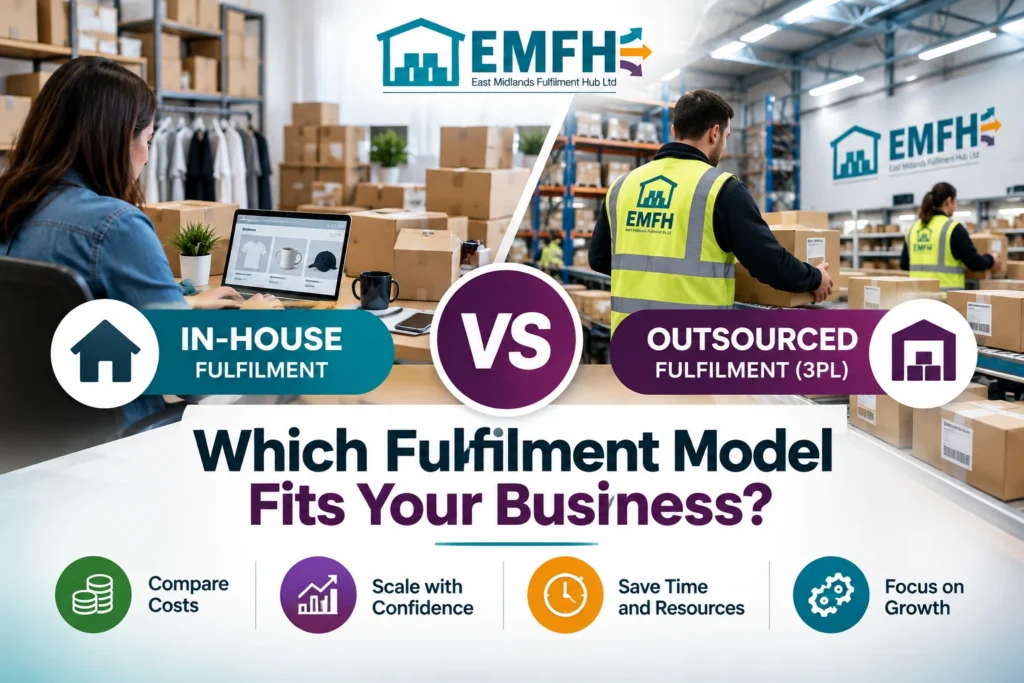
In-house fulfilment gives your team direct control over storing, packing and dispatching orders. Outsourced fulfilment transfers agreed warehouse tasks to a specialist provider. The better choice depends on your products, workload, service needs and the costs you can actually change.
There is no single monthly order count at which every retailer should outsource. A useful decision compares the full operating model and the effect on your team, rather than treating outsourcing as an automatic cost saving.
Where in-house fulfilment works well
Managing orders yourself can suit early-stage sales, products that require specialist personalisation, or a business with an existing warehouse and experienced staff. Your team can inspect unusual orders directly and adapt packing instructions quickly.
That flexibility still needs a process. Stock locations, picking checks and dispatch records become important well before a business feels large. A founder remembering where every item is stored is useful knowledge, but it is difficult to scale or cover during absence.
Where outsourcing can help
A 3PL may be useful when warehouse tasks absorb management time, storage is constrained or growth requires more capacity than your team can provide reliably. It can also suit brands with multiple channels that need a consistent stock and dispatch workflow.
The provider supplies an agreed operation, while you continue to manage product information, customer policies, replenishment and commercial decisions. Read our 3PL guide for the division of responsibilities.
Compare the practical trade-offs
| Decision factor | In-house | Outsourced |
|---|---|---|
| Daily control | Direct supervision of staff and packing | Control through instructions, systems and service reviews |
| Capacity | Depends on your space and staffing | Depends on the provider’s agreed capacity |
| Cost structure | Premises, staff, equipment and materials | Service charges, minimums and retained internal costs |
| Changes | Can be quick but may rely on key individuals | Need documented changes and acknowledgement |
| Peak periods | You arrange labour and collection cover | Forecasts and capacity must be agreed with the provider |
Calculate costs you can change
List current spending on rent, staffing, software, equipment, materials, shipping and operational management. Separate costs you can stop from costs that continue. If a lease runs for another year, outsourcing does not remove that payment immediately.
Model the proposed 3PL costs against the same order history, storage and shipping mix. Include goods-in, returns, special projects and minimum monthly charges. Add transfer freight and setup work as transition costs.
Founder time matters too, but distinguish opportunity from cash. Releasing ten hours a week may create room for sales activity; it does not guarantee ten hours of new revenue. Our fulfilment cost guide helps structure the comparison.
Look for operational signals
- Orders repeatedly miss the promised dispatch window.
- Picking errors rise when one experienced person is absent.
- Storage blocks other business activities or becomes difficult to count.
- Recruitment and peak cover take increasing management time.
- Customer-service work grows because shipment information is unclear.
These signals justify a review, rather than proving outsourcing is the answer. Better layouts, improved product data or a stronger in-house process may solve some of the same problems.
Consider a hybrid model
You can retain specialist products in-house and outsource standard orders, or use different arrangements for different channels. The challenge is coordination: locations need accurate stock allocation, order-routing rules and cancellation procedures.
Make the customer experience clear when one basket produces more than one parcel. The convenience of splitting operations should not create confusing delivery promises.
Plan a controlled move
Agree a stock reconciliation date, product data standard, test orders and launch criteria. Include representative multi-item orders, returns and exceptions in the test. Keep a clear owner for every task during the handover.
Review the early operation against the same baseline you used for the decision: accuracy, dispatch performance, support workload and total cost. Make changes based on actual results.
Frequently asked questions
Should small brands always fulfil orders themselves?
No. Product complexity, available time and storage can justify external help at modest volume. Check commercial fit and any minimum charges.
Will a 3PL handle every custom request?
Only if the service and pricing cover it. Agree personalisation, inserts, gift notes and exception handling in advance.
Can I change models later?
Yes, but stock transfers, systems and contractual notice periods need planning. Review exit terms before starting.
Compare your options with EMFH
Explore EMFH’s pick and pack service and talk to our Nottingham team about your current workflow, peak workload and requirements.