
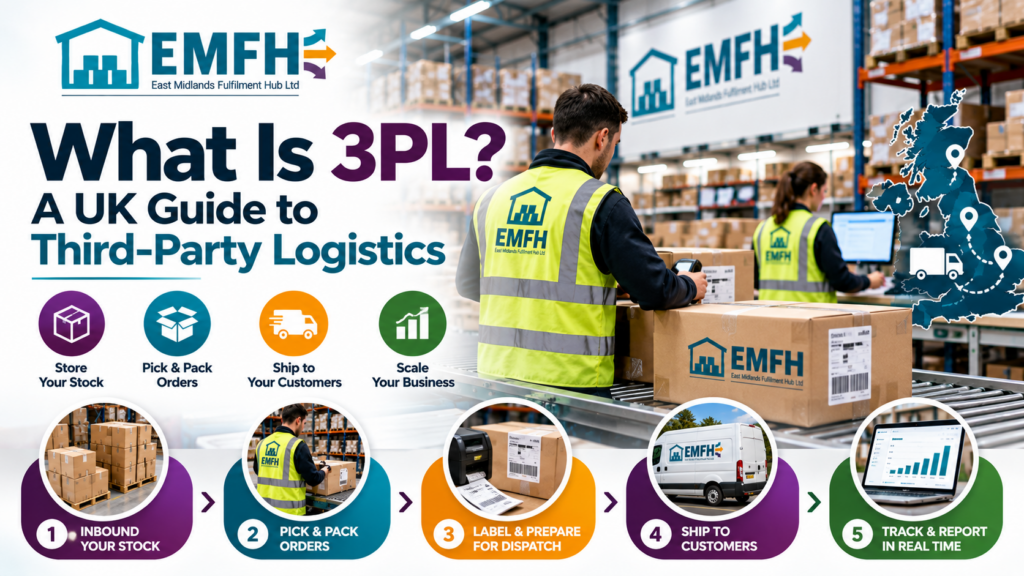
3PL means third-party logistics: using an external specialist to carry out agreed logistics activities for your business. In ecommerce, this commonly includes receiving products, storing stock, picking and packing orders, arranging dispatch and processing returned goods.
A 3PL becomes an operational partner. Your business still decides what to sell, what to promise customers and how to manage its commercial relationships. The provider handles the work specified in your agreement.
How does a 3PL relationship work?
You send stock and product information to the provider. Your sales channels transfer eligible orders into its warehouse workflow. The team prepares those orders, hands shipments to carriers and shares the agreed inventory and dispatch information.
Before launch, both parties need to agree which system controls stock, how exceptions are handled, what services cost and which performance standards apply. The relationship works best when these decisions are written down rather than assumed.
Which services can a 3PL provide?
- Receiving: checking supplier deliveries and recording stock.
- Warehousing: storing products and maintaining location records.
- Order fulfilment: picking items and packing customer shipments.
- Carrier coordination: preparing labels and arranging collections.
- Returns handling: recording, inspecting and sorting returned products.
- Additional preparation: agreed kitting, labelling or marketplace preparation.
Not every provider offers every service. Product restrictions, systems and handling capabilities differ. Review the actual scope for your stock rather than treating “3PL” as a standard package.
3PL versus a courier: who does what?
A courier transports shipments through its delivery network. A fulfilment-focused 3PL prepares the orders before that transport stage and can manage the stock around them. One business may coordinate several carriers, but dispatch performance and carrier delivery performance remain separate measures.
For example, the 3PL might pick and pack a customer’s order correctly and hand it over on time. A later failed delivery still needs an agreed escalation route. Decide who investigates, who updates the customer and who authorises the remedy.
When can outsourcing help?
It can make sense when order preparation takes time away from product development and sales, storage is becoming a constraint, or busy weeks repeatedly exceed your team’s capacity. A partner may also help when multiple channels and returns create coordination work that your current setup cannot manage reliably.
There is no universal order threshold. A small business selling bulky or complex products can need specialist support earlier than a higher-volume business with simple, uniform parcels. Compare workload and total cost, not just parcel count.
What are the trade-offs?
Outsourcing adds provider fees and a dependence on another team’s systems and processes. You may lose the ability to change packing instructions informally at the last minute. Stock transfers, setup work and integration testing also require planning.
In exchange, you can access an established warehouse operation without building every part yourself. Whether that improves the economics depends on your product profile, service requirements, volumes and the agreement. Savings should be calculated, rather than assumed.
What should remain under your control?
Keep ownership of product data quality, sales promises, replenishment decisions and customer policies. The warehouse cannot fulfil unavailable stock or infer an unrecorded change to a product bundle.
Nominate one contact for operational decisions and a backup. Agree how urgent changes are acknowledged, which reports you review and how you approve work outside the standard scope. Small gaps in responsibility can create expensive delays.
Questions to ask a potential 3PL
- Which product types and order profiles suit your operation?
- How are goods-in differences and stock discrepancies reported?
- What order cut-off, collection and exception rules apply?
- Which integrations are supported for my exact sales setup?
- How are returns inspected and recorded?
- What minimums, additional charges and exit terms apply?
Frequently asked questions
Is 3PL the same as fulfilment?
Fulfilment is a set of activities. A 3PL is an external provider that may perform those activities, alongside other logistics services. You can also manage fulfilment in-house.
Can a 3PL support multiple sales channels?
Many can, but confirm the specific integrations, order-routing rules and stock updates for each channel before committing.
Will outsourcing remove all operational work?
No. You still need to plan stock, maintain product data, manage customers and review provider performance.
Discuss 3PL fulfilment with EMFH
East Midlands Fulfilment Hub provides fulfilment services from Nottingham. Review our service range, explore pick and pack fulfilment or request a discussion about your operation. If you are starting with the basics, read our order fulfilment process guide.