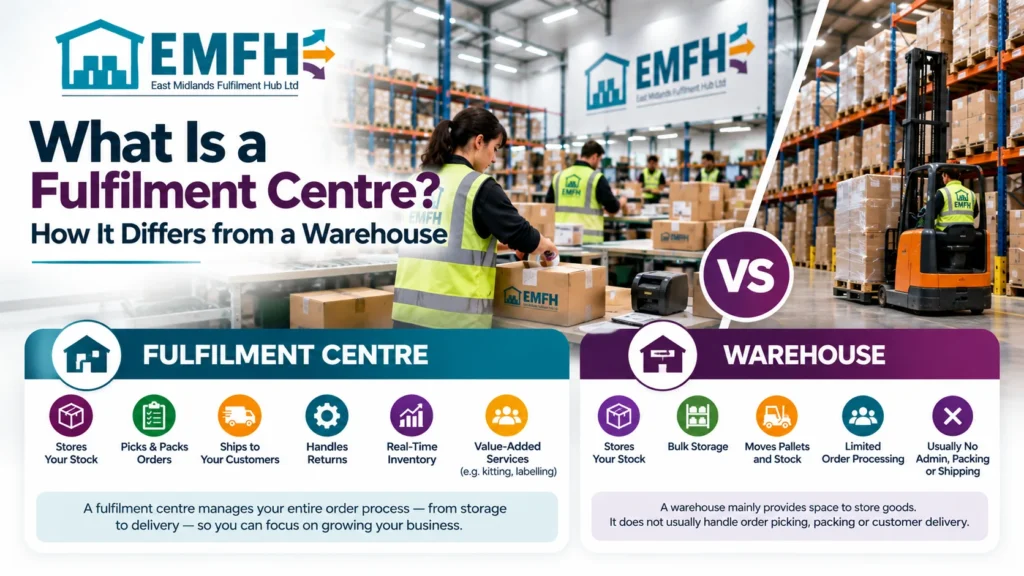
A fulfilment centre is a facility that stores products and prepares customer orders for dispatch. Its role goes beyond holding inventory: it connects stock, order processing, picking, packing, carrier handover and returns in one operational workflow.
For a UK online retailer, the useful question is whether a facility can handle your particular products and order patterns. The label on the building tells you less than its processes, systems and agreed service levels.
Fulfilment centre versus warehouse
A warehouse is a place for storing goods. A fulfilment centre is a warehouse operation organised around completing orders. Many facilities do both, so this is a distinction in function rather than a rigid difference between building types.
| Requirement | Storage-focused warehouse | Fulfilment operation |
|---|---|---|
| Main activity | Holding and moving stock | Preparing and dispatching customer orders |
| Typical movement | Pallets or cartons in and out | Stock receipts plus frequent item-level picks |
| Information needed | Quantities and storage locations | Those records plus customer order and shipping instructions |
| Returns | Depends on the storage agreement | Can include order-linked inspection and restocking |
Check the actual proposal. A storage provider may offer excellent fulfilment capabilities, while a facility marketed as a fulfilment centre may exclude work that your products require.
What happens inside a fulfilment centre?
Receiving and put-away
Staff check incoming goods, identify differences and record where accepted stock is placed. Clear supplier labels and accurate advance delivery information reduce avoidable investigation.
Inventory control
The warehouse system connects products to locations and quantities. Saleable, reserved and quarantined stock should remain distinguishable. Counting routines and exception reporting help maintain that record as goods move.
Order preparation
Eligible orders move into picking and packing. Staff select the right variants, check quantities, protect the contents and prepare the requested delivery service. Read about EMFH’s pick and pack service.
Dispatch and returned goods
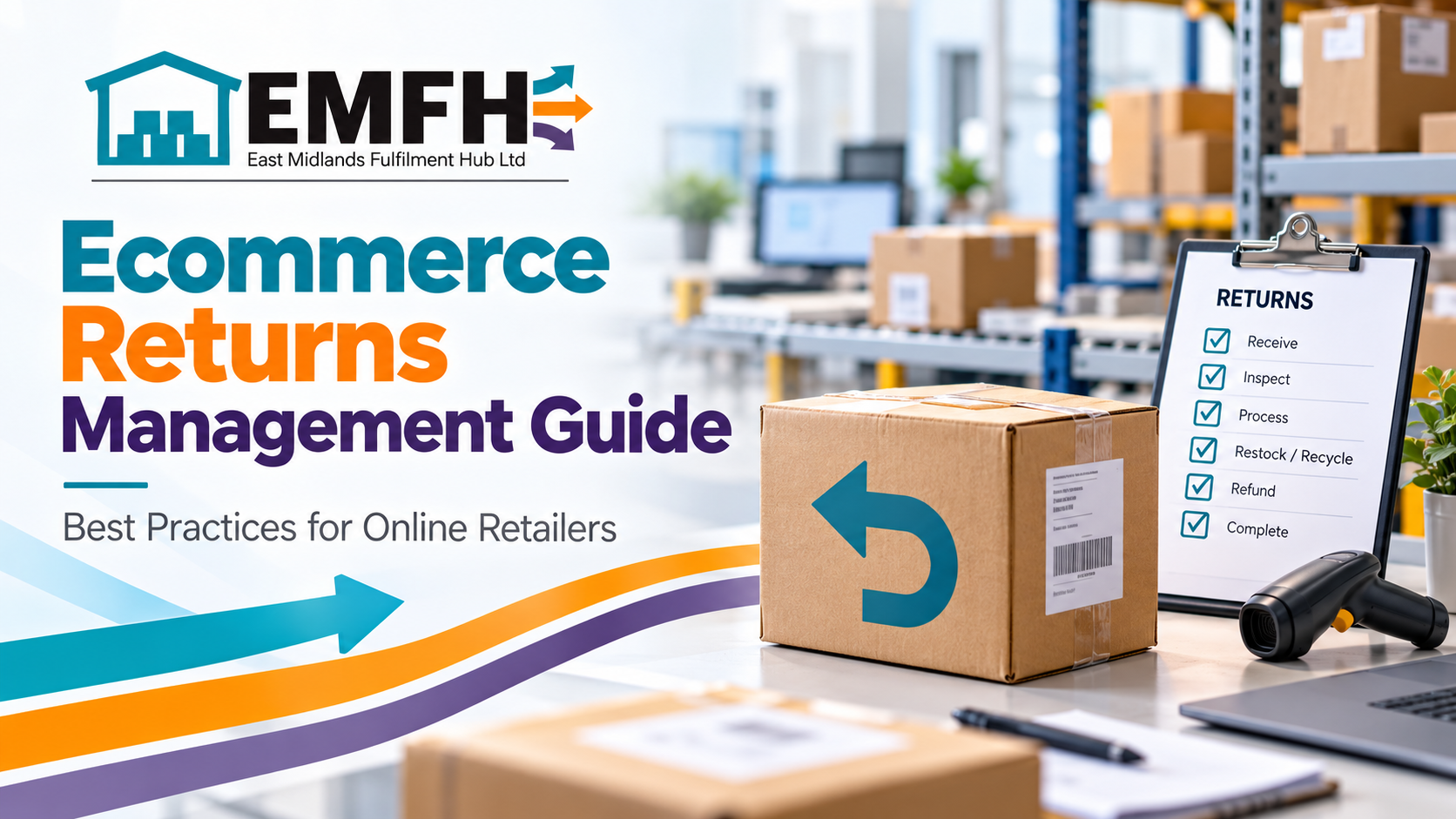
Parcels are prepared for carrier collection and tracking details are recorded. Returns follow a separate workflow so a received item cannot accidentally become available for sale before inspection.
Why location matters, and what it cannot guarantee
A central location can help a retailer access carrier networks and manage inbound journeys. EMFH is based in Nottingham in the East Midlands, serving businesses that need UK fulfilment support.
However, a postcode alone does not guarantee faster delivery or lower costs. Ask about collection times, the actual services available for your parcel sizes, destination coverage and peak-period arrangements. Compare those details with where your customers live and where suppliers send stock from.
What makes a facility suitable for your products?
Start with physical needs. Large products require different handling from small accessories. Fragile items need repeatable protective packaging. Products with batches or expiry dates require relevant traceability and stock-rotation processes.
Then examine operational fit. Can the facility process your usual basket size, bundles, retailer instructions and returns decisions? Discuss any regulated, hazardous, temperature-sensitive or unusually valuable products before arranging delivery. Acceptance and handling requirements must be confirmed specifically.
A practical facility visit checklist
- Follow a sample SKU from receipt to storage and then to an order.
- Ask how damaged or unidentified inbound goods are separated.
- See how similar product variants are checked during picking.
- Review how missed collections and stock discrepancies are reported.
- Discuss access to inventory information and the stock-count process.
- Ask how returned goods are prevented from mixing with approved stock.
Look for a clear explanation rather than an impressive tour alone. A strong process should be understandable and repeatable when the usual account contact is away.
Frequently asked questions
Is a fulfilment centre the same as a distribution centre?
The terms overlap. A distribution centre may focus on moving larger shipments to businesses, while ecommerce fulfilment often involves individual customer orders. Ask which workflows a provider actually supports.
Can I store stock without outsourcing all my orders?
Some providers offer separate storage and fulfilment arrangements. Confirm minimum charges, stock access and outbound handling terms.
Do I need a centre near my office?
Not necessarily. Supplier routes, customer destinations, carrier collections and communication can matter more than proximity to your desk.
Explore fulfilment support in Nottingham
Learn what fulfilment includes, review EMFH’s services or talk to the team about your stock and order requirements.