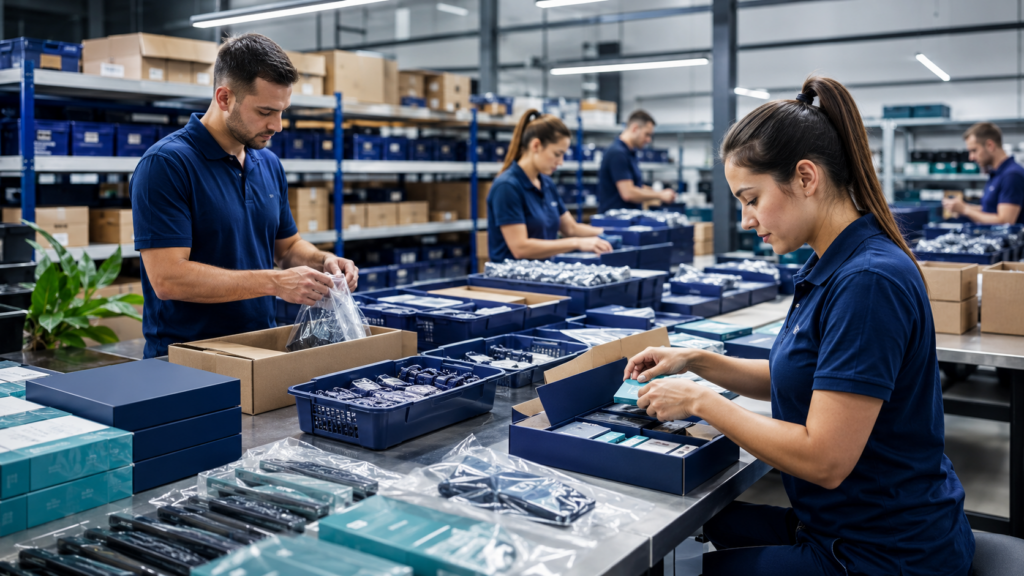
Kitting and assembly bring separate products or components together into a defined finished offer. In eCommerce, that might be a starter pack, gift set, subscription box or promotional bundle. The difficult part is rarely placing items in a box: it is keeping the specification, component stock and finished kit accurate across every order.
This practical guide explains how to brief a UK fulfilment partner, choose between pre-assembly and assembly on demand, and prevent bundle inventory from drifting away from physical stock. It complements EMFH’s kitting, assembly and rework service rather than replacing its commercial specification.
By East Midlands Fulfilment Hub · Published 28 October 2026
What is the difference between a kit, a bundle and rework?
The terms overlap, so define the physical work rather than relying on a label. A kit is an agreed collection of components prepared together. A bundle is the offer presented to the customer; it can exist online before anything has been physically assembled. Assembly is the work of combining the components. Rework changes existing stock, for example by repackaging it or applying an approved replacement label.
A storefront can display three items as one bundle while the warehouse still stores and picks three separate SKUs. Alternatively, a warehouse can build complete sets in advance and hold each finished set as a distinct stock item. Both can work, but they need different inventory rules.
Pre-assembled kits or assembly on demand?
Pre-assemble when the specification is stable
Building kits before orders arrive can make the later picking process simpler. It suits a defined launch quantity, a stable gift set or a campaign with predictable contents. The trade-off is that components become tied up in finished stock. If the offer changes, the kit may need disassembly or rework before those components can be sold separately.
Agree when the stock conversion takes place, where finished kits are stored and how an unbuilt component differs from a completed kit in the stock report. Avoid counting the same item as both available loose stock and available finished stock.
Assemble on demand when flexibility matters
Order-time assembly can preserve flexibility where components also sell individually or the customer chooses a permitted combination. It adds work to the fulfilment stage, so the order instructions must identify every required component, packaging item and insert.
Check the effect on labour planning and dispatch promises before launching a promotion. A process that works for a few orders may need a different layout or production schedule at peak volume. Ask the provider to assess the actual task rather than promising a universal turnaround.
Create a bill of materials before the first run
A bill of materials, often called a BOM, records exactly what makes one finished kit. Give it a revision number so that a packing team can distinguish the approved version from an old attachment. A useful BOM includes more than the saleable products.
- Finished kit name and SKU, including size, colour or other variants.
- Each component SKU and the quantity required per kit.
- Outer packaging, dividers, protective material and seals.
- Inserts, instructions, promotional leaflets and their version.
- Assembly order, presentation requirements and reference photographs.
- Barcode or label instructions and any batch or expiry information to preserve.
- Permitted substitutions, or an explicit instruction that substitutions are not allowed.
For an illustrative stationery starter kit, the BOM might specify one notebook, two pens, one insert and one mailing box. If the warehouse has 100 notebooks and 70 pens, there are components for only 35 complete kits, even if every other item is plentiful. This is a planning example, not an EMFH client result.
Keep component inventory and store availability aligned
The stock available to sell should reflect the component that limits the number of complete kits. This becomes important when the same pen or notebook appears in several offers and is also available individually. A separate spreadsheet that ignores those competing demands can overstate what is ready to sell.
As one platform example, Shopify’s bundle guidance explains that available bundle quantity depends on component stock and the quantities required. That does not prove that a particular warehouse integration handles every bundle configuration correctly. Test the real order and inventory flow.
Before launch, place representative test orders covering a standard kit, a variant, a cancellation and a shortage. Confirm how the order arrives in the warehouse system, when components are reserved or deducted, and what tracking and stock updates return to the store. Our Shopify fulfilment launch checklist provides a wider integration testing framework.
Approve a sample, then control the production run
A sample should show the finished presentation, not just the right component count. Check the opening experience, placement of inserts, protection against movement and visibility of the correct label. Record approval and keep a reference sample or clear photographs at the work area.
During production, separate component staging, assembly, checking and completed stock. The checking method should suit the product and risk: a visual count, barcode check or another agreed control. Record the checks and explain how an affected batch is isolated if a mistake is found.
A weight check can be a useful additional signal for some kits, but it is not proof that the correct variant is inside. Two different products may weigh almost the same. Match the control to the error you need to prevent.
Plan for shortages, substitutions and changes
Decide who can stop the run and who can approve an exception. If a component is short, do not silently reduce the kit contents or use a similar product. Record the missing SKU, quantity, expected replenishment and impact on the production plan.
Treat a new leaflet, different colour or packaging change as a controlled revision. Agree what happens to kits already built under the previous specification. Mixing two versions without a record can create avoidable customer service and stock reconciliation problems.
Work out the total kitting cost
Ask a provider to separate setup or sample work, assembly labour, materials, storage, relabelling and later order fulfilment where applicable. Also discuss failed components, rework, disassembly and disposal of surplus packaging. A quote for a simple two-item set should not be used as the budget for a more complex presentation box.
Compare the total process with assembling internally, including the time needed to manage supplies and correct errors. Our in-house versus outsourced fulfilment guide helps frame that decision without assuming outsourcing is always the cheaper option.
Do not leave returns outside the kit design
A returned kit may contain only some components, opened packaging or an older insert. Define what can return to stock, whether a partial set is quarantined and who approves rebuilding it. Keep returned stock separate until the contents and condition are assessed.
Tell customer service how kit components are recorded so that a refund, replacement or exchange can be reconciled to physical inventory. See our eCommerce returns workflow guide for the receiving and inspection steps.
Questions to ask a kitting provider
- Can you assess this exact product and packaging specification?
- How will components and finished kits be represented in stock reports?
- What sample approval and version-control process will we use?
- How are shortages, substitutions and damaged components handled?
- Which checks are recorded during a run and before release?
- How will bundle orders, cancellations and returns work with our sales platform?
Frequently asked questions
Is selling a bundle the same as physical kitting?
No. A bundle is a selling arrangement. Physical kitting is the warehouse work of preparing its contents together. Confirm whether the offer will be picked as separate components or built into finished stock before orders arrive.
Can a kit use products that also sell individually?
Yes, provided stock availability and reservations account for both uses. Test the component mapping and shortage behaviour before making the bundle available across channels.
Does every kit need a new barcode?
That depends on the finished offer, marketplace and trading-partner requirements. Agree the identification method before producing labels; do not reuse an unrelated product identifier simply because it is convenient.
Discuss your kit specification with EMFH
Send EMFH the component list, proposed quantities, packaging brief and required completion date. The Nottingham team can assess your kitting and rework requirements and explain what information is needed for a practical quote. Start a conversation about your next assembly run.