
Choose a UK fulfilment partner by testing how well its operation fits your products, sales channels, order profile and customer promises. Compare service scope, systems, dispatch arrangements, stock control, returns, total costs and contract terms using the same brief.
The strongest proposal explains how routine orders and difficult exceptions will be handled. This checklist helps you move beyond a headline price or a warehouse tour and assess the working relationship.

Start with a clear operating brief
Prepare your SKU count, dimensions, weights, monthly orders, daily peak, average units per basket and expected growth. Describe your current sales channels, supplier deliveries, returns volume and any labelling or packaging requirements.
Include awkward details: mixed cartons, oversized items, products with expiry dates, bundles and frequent address changes. These are the details that determine whether a provider is a good operational fit.
1. Confirm product and handling suitability
Ask the provider to explain how it would receive, store, pick and pack a representative sample of your range. Confirm any restrictions before transferring stock. An operation designed for small standard parcels may need different processes for large, fragile or specialist goods.
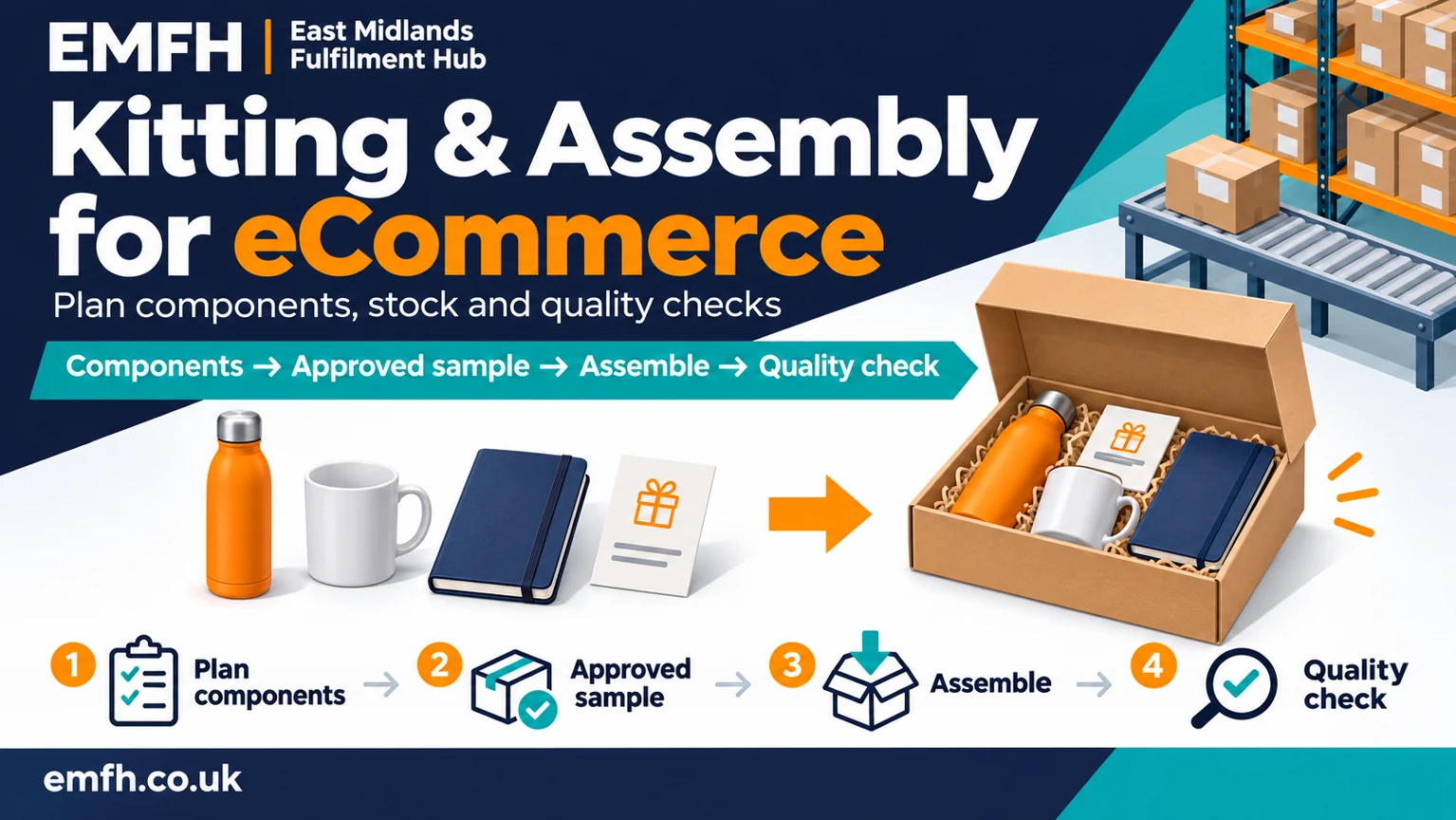
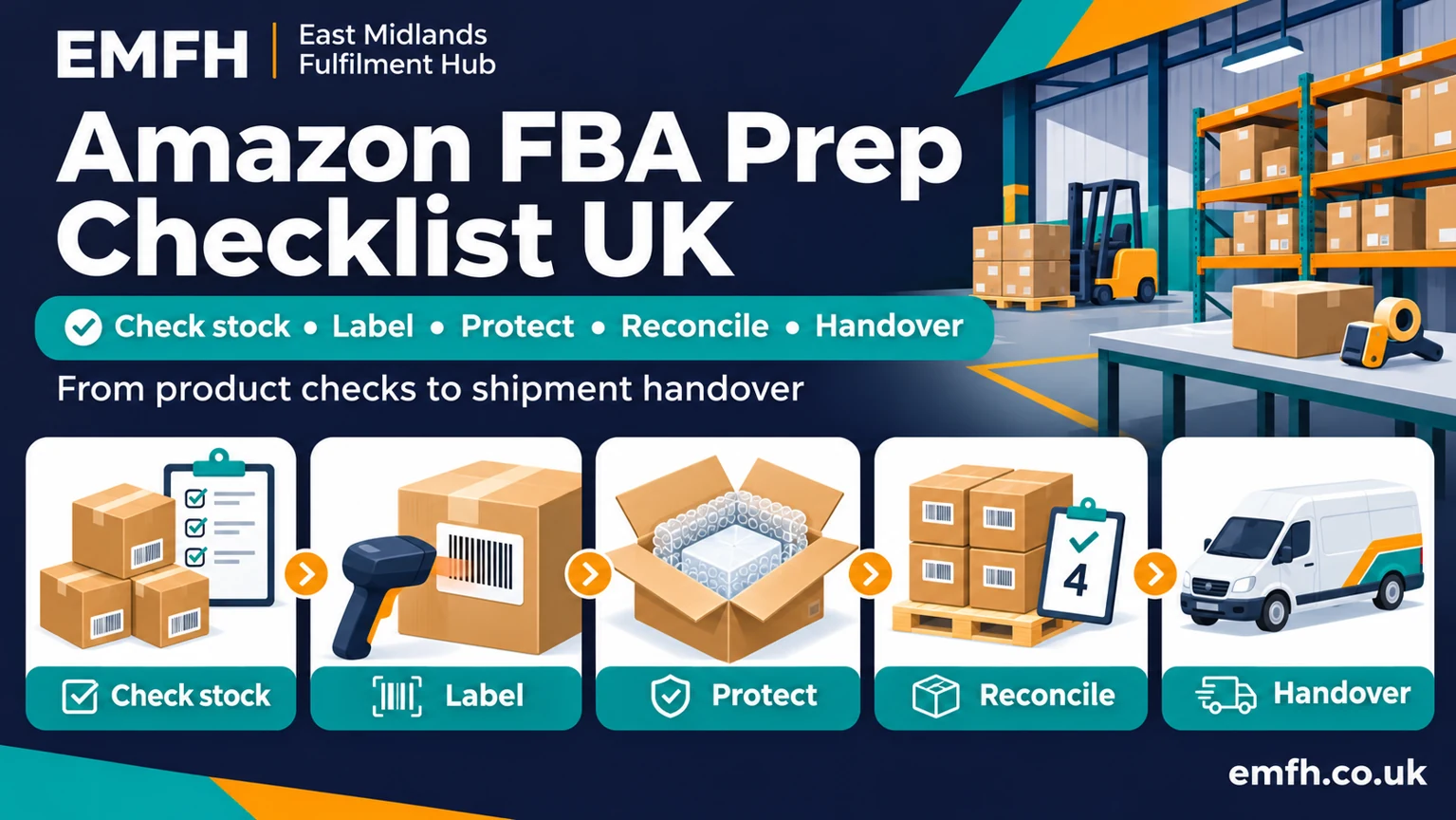
For additional work such as Amazon FBA preparation, agree the exact tasks, approval process and pricing. A general promise of flexibility should become a documented specification.
2. Test the integration with real scenarios
A platform logo on a website is a starting point. Verify the connection for your particular store setup, including order import, product mapping, stock updates and tracking. Ask which system is authoritative when records disagree.
Test multi-item orders, cancellations, partially available stock and returns. Confirm how the warehouse receives and acknowledges urgent changes. A cancellation sent by your store may arrive after picking has started, so timing rules matter.
3. Understand dispatch commitments
Clarify the order cut-off, working days, stock-availability conditions and carrier collection schedule. Ask how a late order, payment hold or invalid address changes the commitment.
Separate warehouse dispatch from carrier delivery. Review the shipping services available for your actual parcel profile and destinations, including any exclusions or additional charges.
4. Examine stock control and reporting
Ask how goods-in differences, quarantine, damaged stock and cycle counts are recorded. Find out what inventory information you can see, how frequently it updates and how discrepancies are resolved.
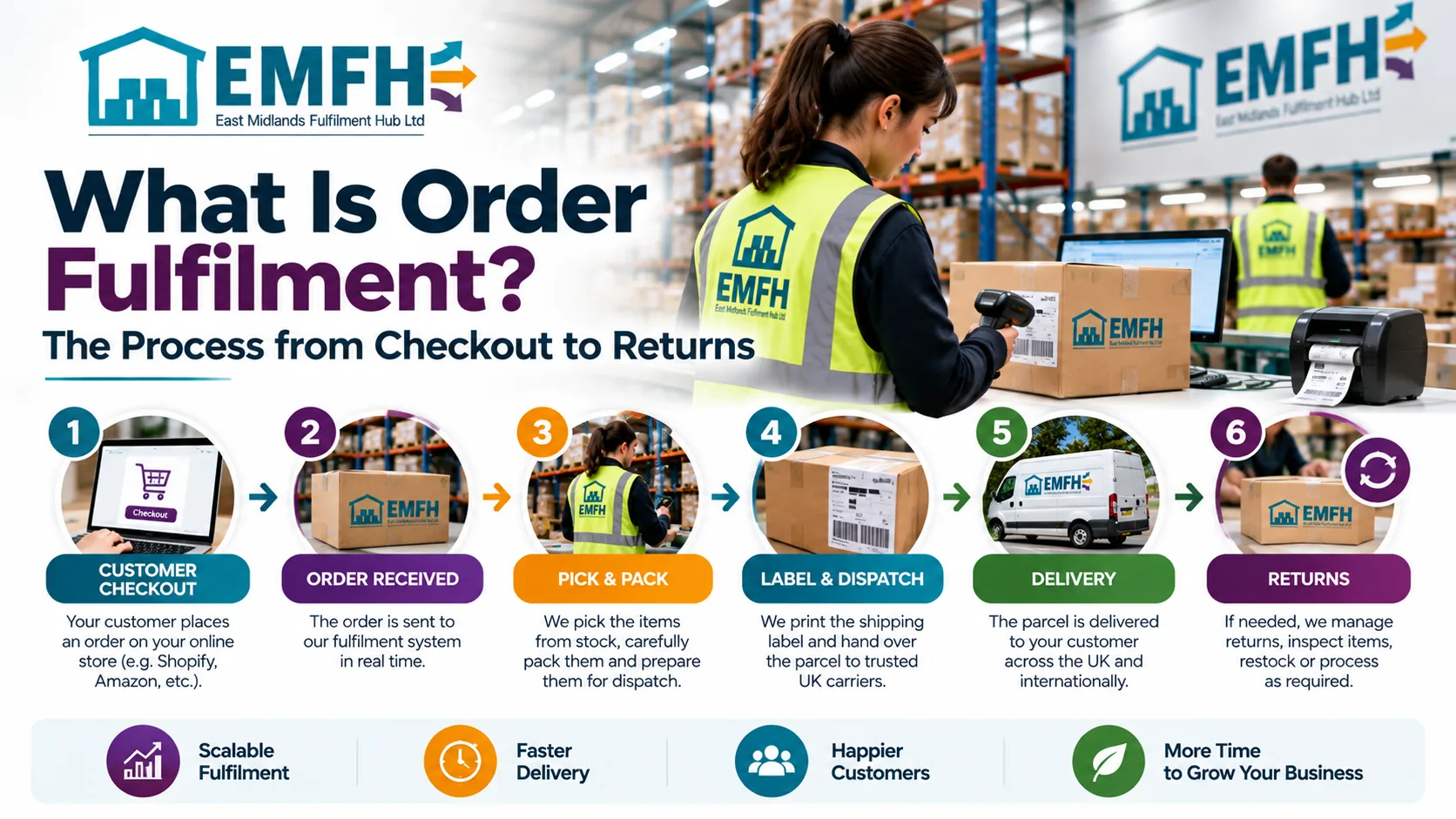
A useful demonstration follows one SKU through receipt, put-away, an order and a return. This tests whether the system provides a traceable stock history, rather than just a total quantity.
5. Agree the returns workflow
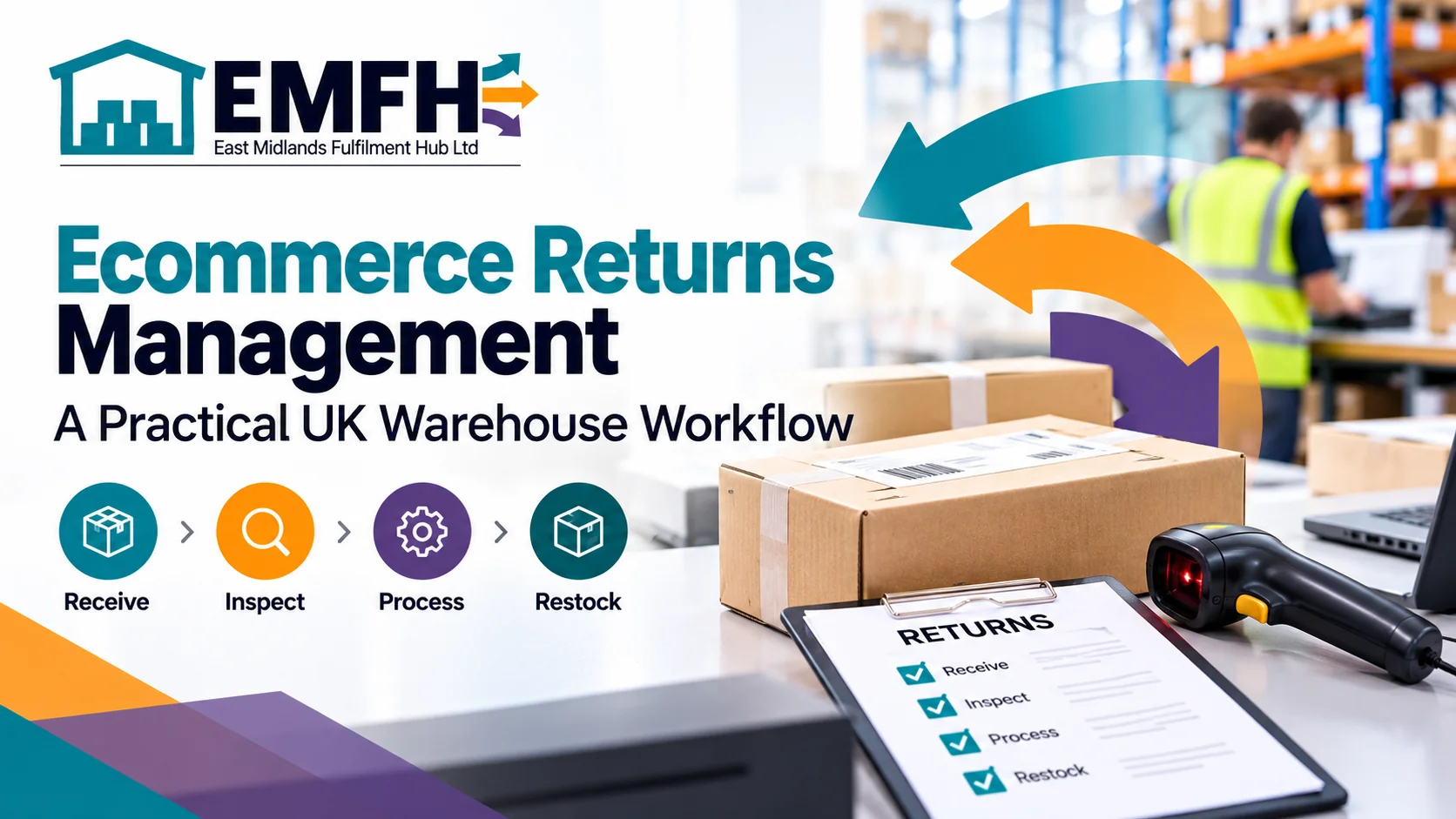
Define the inspection standard, photos required, condition categories and authority to restock, rework or dispose. Establish who decides refunds and how the warehouse communicates inspection outcomes.
Compare turnaround commitments and charges for the actual return work. Read about EMFH’s returns management service when preparing your requirements.
6. Model total costs
Use identical normal, peak and low-volume scenarios for every quote. Include receiving, storage, pick and pack, materials, shipping, returns, minimums and additional work. Keep setup and stock-transfer costs visible.
Our UK fulfilment costs guide provides a comparison framework. Review what triggers a price change and how much notice applies.
7. Check communication and accountability
Who owns your account, who covers absences and how are urgent issues escalated? Agree routine reports and review meetings. Ask to see how an unresolved stock issue would be tracked through to closure.
Where references are available, ask customers with similar requirements about problem resolution and communication. Match testimonials to your needs rather than assuming every customer uses the same service.
8. Review the contract and transition plan
Check service definitions, liability, insurance responsibilities, claims procedures, notice periods and stock-release arrangements. Make sure the pricing schedule and operational specification match the proposal you evaluated.
Plan the transfer: stock reconciliation, product data, test orders, launch date and a fallback route. A short pilot with representative orders can reveal issues before all channels move.
Frequently asked questions
Should I choose the closest warehouse?
Proximity can make visits easier, but product suitability, carrier access, customer destinations and operating performance may matter more.
Is the lowest pick fee the best value?
Only if the full cost and service fit are competitive. Check additional picks, materials, minimums and exception charges.
What should I see during a demonstration?
A routine order, a stock discrepancy and a return. Those examples reveal how the operation works when a transaction needs attention.
Build a shortlist around essential requirements
Before you choose a UK fulfilment partner, separate essential conditions from preferences. An essential condition could be the ability to handle your product category, support a required stock-control rule or meet a retailer’s receiving specification. A preference could be the format of a routine report. Establish these categories before reviewing sales presentations, so a polished demonstration does not distract from a missing capability.
Ask each prospective UK fulfilment partner the same initial questions. Describe the product range, ordinary and peak order mix, storage profile, platforms and preparation work. Request confirmation of exclusions and conditions, not simply a yes or no. A provider may support a product only with particular packaging, an agreed inspection process or a separate charge. Keep those qualifications beside the capability claim.
Use one briefing pack for every proposal
Provide a consistent product file and a representative order history or scenario. State the period covered and explain whether volumes are actual, forecast or illustrative. Include average lines and units per order, destinations, parcel sizes, inbound patterns and returns work. If you revise the pack, send the same revision to all providers still under consideration. Different inputs make otherwise detailed quotes difficult to compare.
Protect customer information when creating samples. Usually, anonymised order lines and destination categories are enough for an initial assessment. Agree any live testing separately. The purpose of a briefing pack is to explain the work, not to distribute unnecessary customer details. Name one contact for clarification and keep a written record of answers that affect scope or price.
A demonstration agenda for a UK fulfilment partner
Request a demonstration based on your examples. Start with a supplier receipt containing a quantity discrepancy. Follow one product into its storage location, then into a multi-item order. Add a cancellation request and a return requiring approval. This sequence shows how the operation manages stock and decisions across several stages instead of only showing a successful dispatch.
Ask the demonstrator to identify the system record, the physical action and the owner of any exception at each stage. If a function is proposed but not available in the demonstration, record it as unverified. A UK fulfilment partner should be able to explain which parts are standard, which require configuration and which depend on another supplier or app. Use that distinction in your comparison.
| Demonstration stage | Question to ask | Evidence to record |
|---|---|---|
| Receiving | How is a short or damaged delivery recorded? | Receiving record and exception route |
| Product mapping | How are similar variants and case quantities distinguished? | SKU mapping and unit of measure |
| Order release | Which holds prevent picking? | Eligibility rules and approval owner |
| Cancellation | How is the final outcome confirmed? | Request, response and shipment state |
| Dispatch | What information returns to the store? | Carrier, tracking and status update |
| Returns | Who authorises the stock outcome? | Inspection evidence and approval |
For a Shopify store, compare the proposed cancellation and fulfilment-request behaviour with Shopify’s official app fulfilment guidance. Confirm the actual app and configuration used for your account. Do not assume that changing an order status in the store proves an accepted warehouse instruction has stopped. Include that scenario in the agreed test plan.
What to observe during a site visit
A visit can help you understand the physical flow and meet the team, but it is not a substitute for testing your account. Ask how receiving, available stock, quarantine, packing and returns are separated. Discuss how products are identified and how instructions reach staff. Confirm the visit and any sample handling with the provider rather than arriving with unbooked stock.
Use the visit to connect the proposal to practical questions. Where would your product be stored? How would staff identify a fragile variant or an incomplete kit? What happens if a delivery arrives without the expected information? A UK fulfilment partner may have a different layout from your current operation and still be suitable. Assess the controls and workflow, rather than appearance alone.
Create a scorecard with evidence and open conditions
Use an agreed scoring method to make the decision reviewable. A simple illustrative scale is zero for unsupported or unavailable, one for a stated capability, two for a demonstrated workflow and three for a tested workflow meeting the agreed result. These numbers describe your evaluation method, not an industry certification. Keep essential conditions separate so a high average cannot conceal a critical failure.
When comparing a UK fulfilment partner, record the source of each score: demonstration date, test result, written answer or proposal section. Mark assumptions clearly. If a provider proposes a feature that will be configured later, identify the acceptance condition and who must confirm it. Do not give the same confidence to a future plan and an observed result simply because both appear in a proposal.
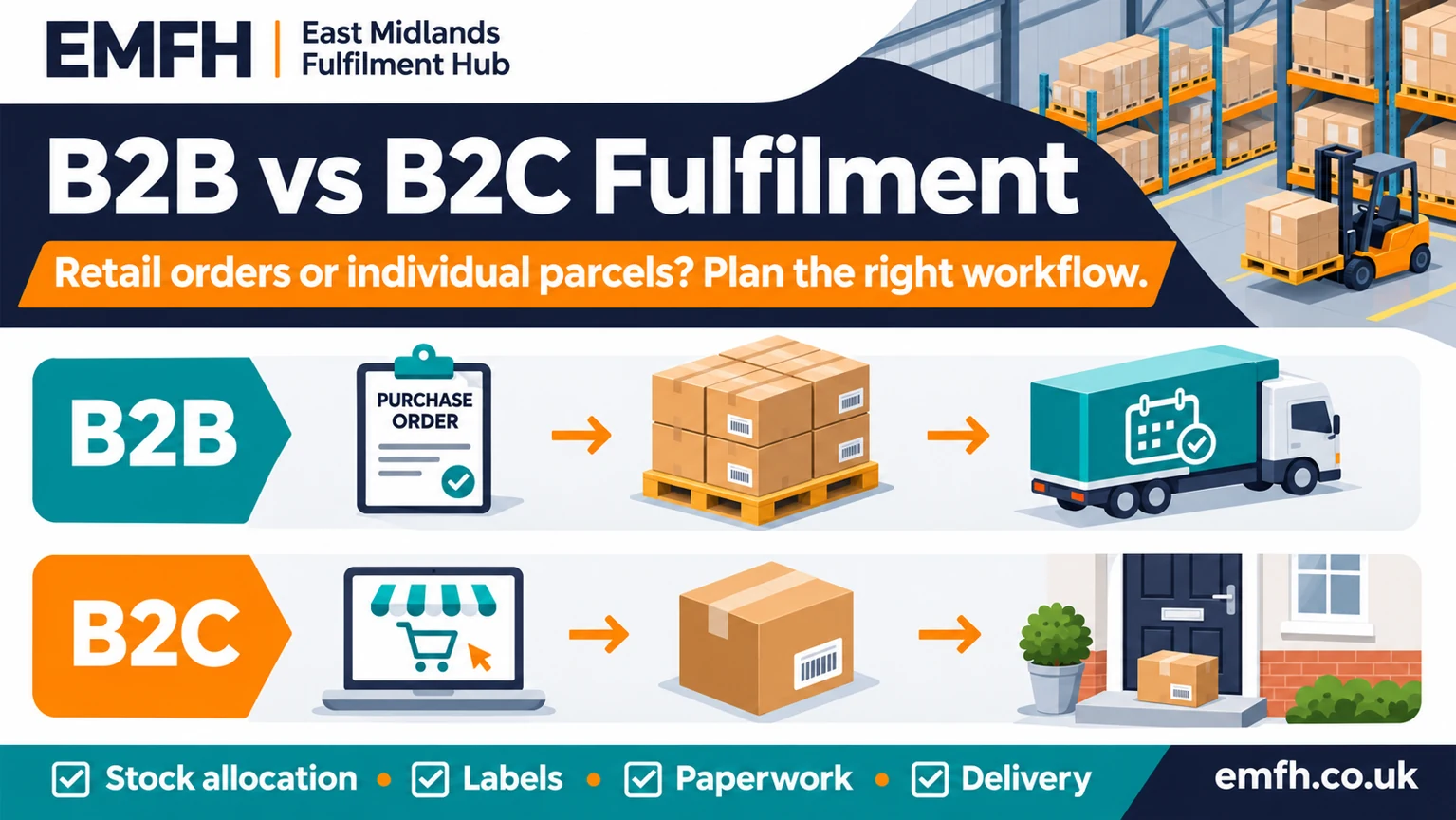
Apply weights only where they reflect your business. A retailer supplying trade customers may place more importance on delivery bookings and receiving labels than a brand shipping simple consumer parcels. A seller with complex bundles may prioritise assembly and stock reconciliation. Agree the importance before seeing the final totals, and explain why the selected UK fulfilment partner meets the essential requirements.
Compare service fit beside the full cost
Keep the cost model and operational scorecard connected. A lower quote may cover fewer tasks or assume simpler orders. Record normal, peak and low-volume scenarios using identical assumptions for every provider. Separate one-off onboarding and transfer work from recurring charges. Include the internal responsibilities and commitments that remain after outsourcing, so a service quote is not mistaken for the business’s entire fulfilment cost.
Ask each provider to explain the charging unit for receiving, storage, first and additional picks, materials, transport, returns and project work. Confirm any minimums, surcharges and approval requirements. If an input is uncertain, show a range instead of an apparently final number. The aim is to choose a UK fulfilment partner using a comparable scope and a transparent model, not simply the lowest visible pick fee.
Use references to investigate the working relationship
Where customer references are available, ask about requirements similar to yours. Useful topics include onboarding, communication during a stock discrepancy, handling a specification change and reviewing recurring problems. Avoid asking only whether the customer is happy. A positive relationship with a simple product range may not answer questions about your own specialist workflow.
Ask when the reference last used the relevant service and whether its operation changed over time. Keep personal opinions distinct from documented capability. A UK fulfilment partner should still demonstrate your essential requirements even when references are positive. Testimonials support the assessment; they do not replace a product, systems and service test for your account.
Turn the selected proposal into an acceptance plan
Before moving inventory, reconcile the proposal, pricing schedule and operational brief. Identify any unresolved conditions and the person who can approve them. Confirm the current product data, packing standard, stock statuses, order-routing rules and exception contacts. The acceptance plan should state what must be complete before the account begins handling the agreed live scope.
Use a controlled pilot where practical. Select representative orders, define the opening stock balance and record expected results. After the pilot, review actual stock movements, dispatch information, returns handling and manual interventions. A UK fulfilment partner selection is stronger when the final approval rests on those outcomes rather than on an assumption that all unanswered questions will be resolved after launch.
Plan the transfer without losing order ownership
Agree the last order handled by the old route and the first handled by the new route. Decide how in-progress orders will finish and how stock in transit is represented. Check that a live order cannot be released at both locations. Retain the transfer record and receiving reconciliation so any later quantity difference can be traced to an identifiable event.
Set a fallback for a failed critical check. It may mean postponing the switch, limiting the first launch to a product group or pausing release while an issue is corrected. Confirm the supported controls with the store administrator and warehouse. A fallback should have a decision owner and a clear end condition; it should not depend on staff improvising duplicate manual orders.
Review the selection after the first operating period
Keep the decision record and compare actual performance with the original assumptions. Review billed quantities, order mix, stock holding, exceptions and retained management effort. Explain differences before changing the conclusion. A new promotion or product range can alter the operation, while a recurring mapping error may need a specific correction within the selected arrangement.
The objective is to choose a UK fulfilment partner that can support your current needs and assess changes clearly. Product suitability, reliable records, tested workflows and accountable communication remain useful as the business grows. Revisit the scope when a material assumption changes, and keep the approved brief current so both teams continue working from the same instructions.
A scorecard example: essential conditions come first
This is an illustrative selection example, not a comparison of named providers. A brand needs a specific retailer label and delivery-booking process for an important sales channel. One proposal performs well on reporting and presentation, but the required retail workflow has not been demonstrated. Another proposal has a less polished dashboard but has passed the relevant receiving and shipment tests.
The brand should not allow an average score for minor preferences to conceal the unverified essential condition. It can ask the first provider to demonstrate and test the workflow before approval, restrict the initial scope if that is practical, or continue evaluating alternatives. Record the condition and its acceptance evidence rather than treating an unsupported assurance as a passed test.
Use the same discipline for your UK fulfilment partner comparison. A missing capability and a missing piece of evidence are different issues, but both need a decision before the affected work goes live. Name the person who can accept the result and keep the basis for that acceptance. This makes the final recommendation easier to explain to stakeholders and easier to revisit if the business later changes its requirements.
When a proposal changes during selection, update the comparison before approving it. Record the changed scope, price assumption and acceptance condition, and confirm which document is current. A UK fulfilment partner may offer an alternative workflow that is suitable, but stakeholders need to understand what they are approving. Keep the final recommendation tied to the agreed operation rather than an earlier presentation.
Assess EMFH against your requirements
Review our fulfilment services and contact EMFH in Nottingham with your operating brief. We can discuss the fit, required workflows and information needed for a tailored proposal.