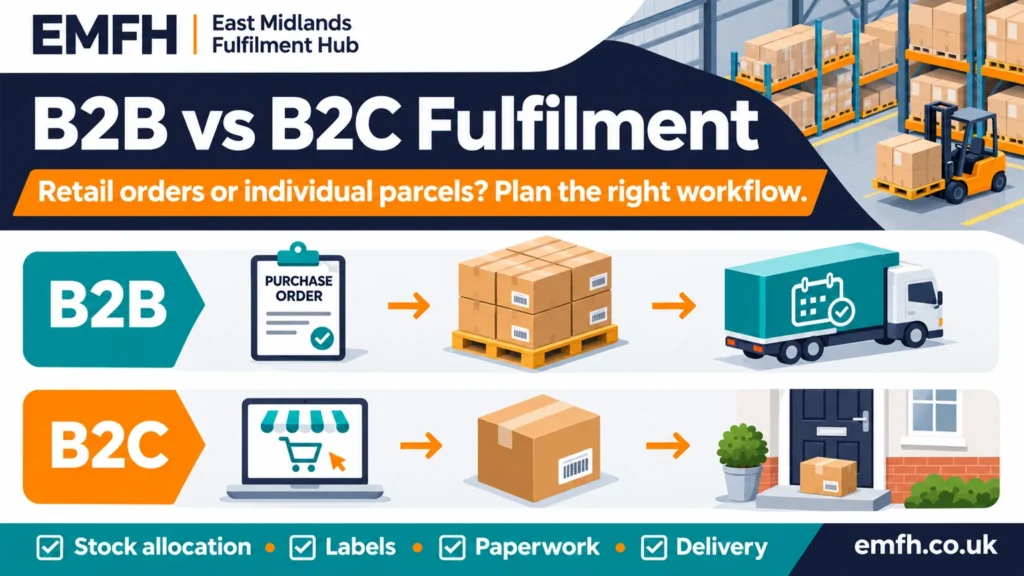
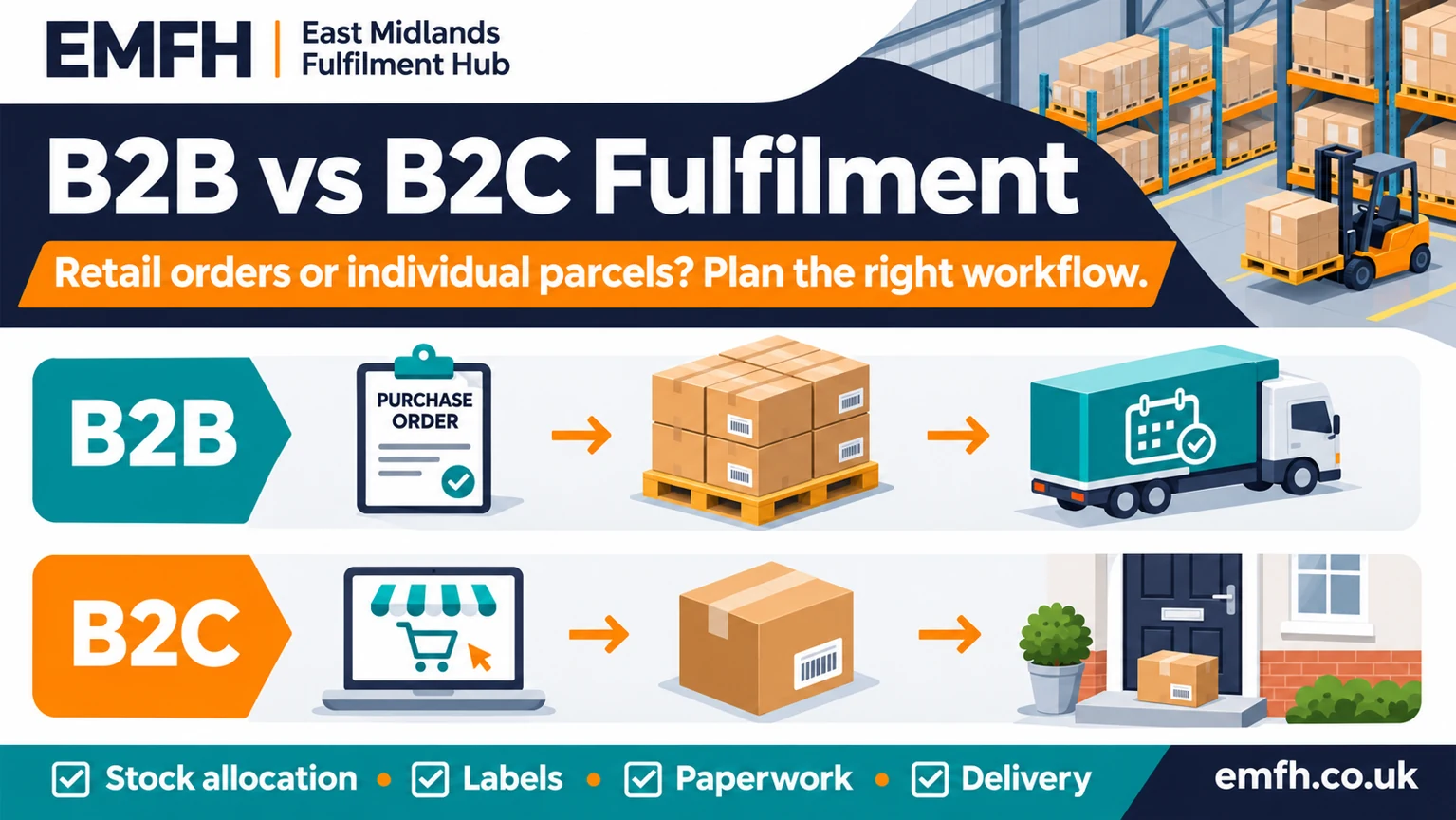
B2B vs B2C fulfilment compares two order workflows. B2B fulfilment prepares and delivers orders for other businesses, such as shops, wholesalers and retail distribution centres. B2C fulfilment sends orders to individual consumers. The difference is not simply a bigger order: business customers may require specific case quantities, product identifiers, delivery bookings and documentation.
For a UK brand selling through its own website and into retail, a single stock pool needs clear rules for both channels. This guide explains the operational differences and gives you a retail order checklist to use before accepting a new customer’s purchase order.
By East Midlands Fulfilment Hub · Published 28 October 2026
In this guide
- B2B vs B2C fulfilment: the practical differences
- B2B vs B2C fulfilment: 6 essential retail order checks
- B2B vs B2C fulfilment: a shared-stock example
- B2B vs B2C fulfilment: map units, cases and customer codes
- B2B vs B2C fulfilment: test shared stock reservations
- B2B vs B2C fulfilment: build a customer instruction pack
- B2B vs B2C fulfilment: control amendments after picking starts
- B2B vs B2C fulfilment: review a trial order before launch
B2B vs B2C fulfilment: the practical differences
Order structure
A consumer order often consists of a small number of individual products, identified by a store order number. A B2B order may use a purchase order and specify full cases, mixed cartons, pallets or agreed pack multiples. Confirm whether a quantity of twelve means twelve individual units or twelve cases.
A larger parcel order is not automatically a pallet order. Choose the handling unit from the product, quantity and customer requirements. EMFH’s B2B fulfilment service is a separate commercial conversation from its B2C and DTC fulfilment service.
Delivery and receiving
A consumer usually needs a correctly addressed parcel and an appropriate delivery service. A retail distribution centre may require an appointment, a particular delivery reference and a defined unloading arrangement. Its receiving team may reject a delivery that arrives outside the agreed process even when the products are correct.
Capture the actual receiving instructions before choosing the carrier or confirming a date. Do not assume that a parcel carrier, pallet network and dedicated vehicle provide interchangeable services.
Packaging and presentation
Consumer packaging usually protects the items for their final customer journey and may include branded presentation. Business packaging may need to preserve case quantities, make stock easy to receive and identify the contents at carton or pallet level. Retail-ready packaging, if requested, should be described in the customer’s specification.
Both channels require care, but a specification for one should not be copied blindly to the other. Product protection, handling and the receiving process should determine the final configuration.
B2B vs B2C fulfilment: 6 essential retail order checks
1. Purchase order and line-item accuracy
Record the customer name, delivery location, purchase order reference, delivery window and contact for exceptions. Match every customer item code to your own SKU and the agreed description. Check variants, pack sizes and whether quantities are stated in units, cases or another measure.
Agree how amendments are authorised. If the purchase order changes after picking begins, confirm how the warehouse receives the revision and how the old instruction is withdrawn. A note sent to one person’s inbox is not a reliable way to control a live order.
2. Stock allocation across channels
Decide when business stock becomes reserved. Without that rule, a large order may be promised to a retailer while the same stock remains available to online customers. Check the effect on safety stock, replenishment and any kit components used elsewhere.
Confirm how partial availability is handled: hold the order, send an agreed part shipment or propose a revised date. The customer should approve a change before the dispatch team works around the shortage.
3. Case and pallet configuration
Specify the number of units per case, whether mixed cases are allowed and how products should be grouped. If the shipment uses pallets, confirm the required pallet type, loading configuration and any customer limits using the receiving specification.
Document how the load will be protected and identified. Do not invent a universal retailer pallet height or weight limit; different customers and delivery services can set different conditions. Photographs of the agreed configuration can help resolve a query after collection.
4. Product and logistics identification
Product identification and shipment identification serve different purposes. A product code identifies a trade item, while a logistics identifier can distinguish a specific handling unit within the shipment. Check the customer’s label format, references and barcode requirements before printing.
For example, GS1 UK’s logistics label guidance describes using an SSCC to identify a logistics unit and a GS1-128 barcode to carry it. This is relevant where a trading partner requires that standard; it is not a reason to claim every B2B parcel needs the same label.
5. Booking, notices and paperwork
Identify who arranges the delivery booking and how the booking reference reaches the carrier. Check the requested packing list, delivery note and any advance shipping notice. An advance shipping notice, often called an ASN, tells a customer about an expected shipment; EDI is a way trading partners can exchange structured business messages.
Ask whether the particular customer requires EDI or offers a portal or another approved route. Confirm that the warehouse and seller can deliver that workflow before promising a capability. The information in the notice, labels, purchase order and physical shipment should reconcile.
6. Release and delivery evidence
Before release, compare the picked quantities, packing record and delivery documents with the approved order. Keep a record of unresolved issues, the person authorising dispatch and the handover to the carrier.
After delivery, retain the proof of delivery and any shortage or damage notes. Set an owner for investigating discrepancies so that customer service, the warehouse and finance are working from the same shipment record.
B2B vs B2C fulfilment: a shared-stock example
Imagine a homewares brand receives a retailer order for ten cases of six mugs while online shoppers continue buying individual mugs. The brand must reserve sixty units for the retailer, preserve the six-unit case configuration and agree how those cases will be transported and labelled.
The consumer orders can continue through their normal workflow only against the remaining available stock. If a mug is damaged during the B2B pick, the team needs an approved shortage or replacement process rather than quietly taking an item already allocated elsewhere. This is an illustrative example, not an EMFH case study.
Compare B2B vs B2C fulfilment costs
Share a representative order, the receiving specification and expected order frequency. Ask which activities are included: receiving, storage, case picking, pallet building, labels, bookings, notices, transport and exception handling. Identify which tasks are charged per order, line, case, pallet or hour.
Compare like-for-like work rather than comparing a B2B price with a consumer per-item picking fee. Our UK fulfilment cost guide provides a broader checklist, while warehousing and storage covers the stockholding side of the operation.
Questions to ask before choosing a retail fulfilment partner
- Can you review this customer’s actual supplier and delivery specification before we commit?
- How are unit, case and pallet quantities represented in the warehouse system?
- When is stock reserved, and how do changes reach the picking team?
- Who creates labels, arranges bookings and sends any required notice?
- What approval is needed for substitutions, partial shipments and rework?
- Which records will be available for a shortage or delivery dispute?
B2B vs B2C fulfilment: frequently asked questions
Can one fulfilment partner support B2B and B2C orders?
Potentially, yes. Check how it separates the order rules while keeping inventory consistent. Ask for the workflow for your products and customer requirements rather than assuming that one integration covers every channel.
Is EDI required for every B2B order?
No. The trading partner determines the required exchange method. Some customers use a portal or another agreed process. Confirm the requirement and the supported workflow before accepting the order.
Does every business shipment need a pallet?
No. B2B orders can travel as parcels, cases or pallets depending on their contents and the delivery arrangement. Confirm packaging, handling and receiving requirements before booking transport.
B2B vs B2C fulfilment: map units, cases and customer codes
Create a product mapping before accepting an unfamiliar retail order. Record your SKU alongside the customer’s item code, the item description, the number of units in a case and any agreed outer packaging. Check this against the physical stock. A price list and a warehouse picking instruction may use different units of measure even when they describe the same product.
The B2B vs B2C fulfilment distinction matters when a stock system receives a quantity without enough context. Ten consumer units and ten cases of six represent very different commitments. Make the conversion explicit in the order workflow and test it before launch. Keep a named owner for product mapping so that a retailer code change does not become an improvised warehouse decision.
Ask how mixed cases and broken cases are represented. If the customer expects complete cases, loose units should not be substituted without approval. If mixed cases are allowed, define the permitted combination and identification method. Save a representative order and its accepted warehouse interpretation as a reference for future checks.
B2B vs B2C fulfilment: test shared stock reservations
Start with a controlled test using known quantities. Reserve a business order, then check what remains available to the online store. Cancel or amend the test order and check that the released quantity returns to the correct stock pool. The result should be explainable in physical units, even when the sales channel uses cases or another measure.
For B2B vs B2C fulfilment planning, decide whether reservations happen at order acceptance, payment approval or another agreed milestone. The right rule depends on the commercial agreement and supported systems. Document it rather than letting each person assume a different point. Otherwise a retailer commitment can sit outside the availability calculation used by consumer channels.
Check shortages and damaged stock in the same trial. If two units are moved to a hold status, they should not remain available to a different channel merely because that channel uses another order type. Review the stock report after each test and keep evidence of the expected outcome. Resolve unexplained differences before trusting a large live order.
B2B vs B2C fulfilment: build a customer instruction pack
A customer instruction pack brings the approved receiving requirements together. Include the destination, contact, booking process, order references, packaging specification and document requirements. Mark the version and review date. Where a retailer supplies a portal or supplier manual, identify which current instruction applies to the actual destination rather than copying a rule from another customer.
When reviewing B2B vs B2C fulfilment requirements, check whether a delivery location has special access or unloading arrangements. Pass confirmed requirements to the transport provider before booking. A promised delivery date is only useful if the carrier service and receiving arrangement can support it. Ask for any unresolved requirement to be raised before stock is packed.
Give the team an approval route for conflicting instructions. A purchase order might request one delivery window while a later booking offers another. Record the agreed resolution and update the active instruction. Keep the original communication for reference, but make the final approved version easy to identify at the point of dispatch.
B2B vs B2C fulfilment: control amendments after picking starts
An amendment needs a reference, a version and a clear effective point. Record what changed: product, quantity, destination, packaging or delivery date. Identify whether picking, packing or booking has already started. The warehouse should acknowledge the change before the seller assumes that an email has stopped the original process.
Use your B2B vs B2C fulfilment workflow to distinguish changes that affect inventory from changes that affect transport or paperwork. Reducing the quantity can release stock, but only after the physical pick and reservation are corrected. Changing an address can require a new carrier arrangement. Treating every amendment as a simple note risks leaving one part of the order unchanged.
Decide who approves additional work and how it is priced. Repacking a completed order, replacing labels or cancelling a booking may create work outside the initial brief. Ask for the consequence before authorising the change, and keep that approval with the shipment record. This supports a clearer discussion if an invoice or completion date changes.
B2B vs B2C fulfilment: plan returns and delivery exceptions
Do not wait for a failed delivery to decide where the stock should go. Agree who receives carrier notifications, who contacts the customer and who can authorise redelivery or return. Keep rejected delivery stock identifiable until its condition and paperwork are checked. A parcel or pallet coming back through the door is not automatically available inventory.
The returns side of B2B vs B2C fulfilment can involve different commercial references. A retailer may return stock against an agreed authorisation, while a consumer return refers to an individual order. Match the physical goods to the relevant record before approving a stock adjustment. Count the received units and record their condition rather than copying the quantity on the return request.
Where kits, labels or retail packaging are involved, define whether returned goods need rework before resale. Use the warehouse returns workflow for receiving and inspection principles, and the kitting and assembly guide for component and specification controls. The final disposition should follow the agreed product and customer requirements.
B2B vs B2C fulfilment: review a trial order before launch
Choose one representative order for each channel and follow it from acceptance to the dispatch record. Confirm the SKU mapping, reservation, picked quantity, packaging and delivery references. Use a trial to expose unclear instructions, not to claim that every future order will meet the same timing. Add a more complex case if mixed products or multiple destinations are part of the expected workload.
A B2B vs B2C fulfilment launch review should include the seller, warehouse and whoever manages customer communication. Each team sees a different part of the order. Compare their records so that a correctly picked shipment does not leave with an outdated notice or an unconfirmed booking. Assign an owner to every unresolved point before launch.
After the first live deliveries, compare actual exceptions with the trial assumptions. Look for recurring mapping questions, stock discrepancies, incomplete documents and receiving problems. Record what changed and when the new instruction took effect. A short review with clear actions is more useful than collecting delivery data without changing the process that caused the issue.
For a useful first enquiry, include a typical consumer order alongside a typical retail purchase order. State monthly order ranges, SKU count, storage needs and any confirmed receiving requirements. This lets a provider assess both workflows together and identify missing information before quoting. Review the response against the same brief so that storage, handling and delivery assumptions remain comparable across proposals.
Plan your B2B fulfilment brief with EMFH
EMFH provides B2B fulfilment from Nottingham. Send an example purchase order, product details and your customer’s receiving requirements so the team can assess the work and agree responsibilities. Contact EMFH about retail and wholesale fulfilment.
Further reference: GS1 UK: creating SSCCs and logistics labels. Always use the current specification supplied by the actual receiving customer.