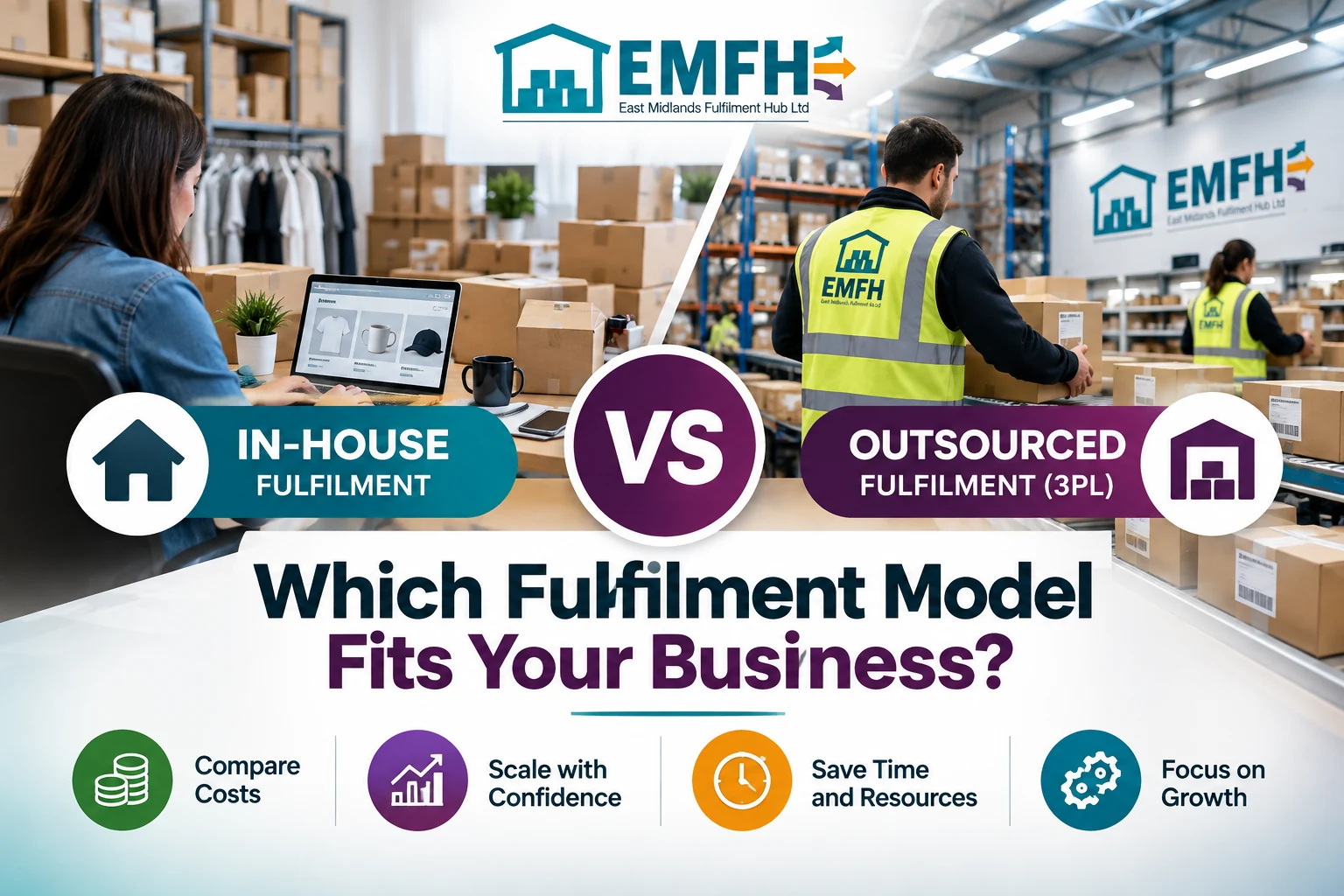

B2B fulfilment prepares and delivers orders for other businesses, such as shops, wholesalers and retail distribution centres. B2C fulfilment sends orders to individual consumers. The difference is not simply a bigger order: business customers may require specific case quantities, product identifiers, delivery bookings and documentation.
For a UK brand selling through its own website and into retail, a single stock pool needs clear rules for both channels. This guide explains the operational differences and gives you a retail order checklist to use before accepting a new customer’s purchase order.
By East Midlands Fulfilment Hub · Published 28 October 2026
B2B and B2C fulfilment: the practical differences
Order structure
A consumer order often consists of a small number of individual products, identified by a store order number. A B2B order may use a purchase order and specify full cases, mixed cartons, pallets or agreed pack multiples. Confirm whether a quantity of twelve means twelve individual units or twelve cases.
A larger parcel order is not automatically a pallet order. Choose the handling unit from the product, quantity and customer requirements. EMFH’s B2B fulfilment service is a separate commercial conversation from its B2C and DTC fulfilment service.
Delivery and receiving
A consumer usually needs a correctly addressed parcel and an appropriate delivery service. A retail distribution centre may require an appointment, a particular delivery reference and a defined unloading arrangement. Its receiving team may reject a delivery that arrives outside the agreed process even when the products are correct.
Capture the actual receiving instructions before choosing the carrier or confirming a date. Do not assume that a parcel carrier, pallet network and dedicated vehicle provide interchangeable services.
Packaging and presentation
Consumer packaging usually protects the items for their final customer journey and may include branded presentation. Business packaging may need to preserve case quantities, make stock easy to receive and identify the contents at carton or pallet level. Retail-ready packaging, if requested, should be described in the customer’s specification.
Both channels require care, but a specification for one should not be copied blindly to the other. Product protection, handling and the receiving process should determine the final configuration.
The retail order checklist: confirm these points first
1. Purchase order and line-item accuracy
Record the customer name, delivery location, purchase order reference, delivery window and contact for exceptions. Match every customer item code to your own SKU and the agreed description. Check variants, pack sizes and whether quantities are stated in units, cases or another measure.
Agree how amendments are authorised. If the purchase order changes after picking begins, confirm how the warehouse receives the revision and how the old instruction is withdrawn. A note sent to one person’s inbox is not a reliable way to control a live order.
2. Stock allocation across channels
Decide when business stock becomes reserved. Without that rule, a large order may be promised to a retailer while the same stock remains available to online customers. Check the effect on safety stock, replenishment and any kit components used elsewhere.
Confirm how partial availability is handled: hold the order, send an agreed part shipment or propose a revised date. The customer should approve a change before the dispatch team works around the shortage.
3. Case and pallet configuration
Specify the number of units per case, whether mixed cases are allowed and how products should be grouped. If the shipment uses pallets, confirm the required pallet type, loading configuration and any customer limits using the receiving specification.
Document how the load will be protected and identified. Do not invent a universal retailer pallet height or weight limit; different customers and delivery services can set different conditions. Photographs of the agreed configuration can help resolve a query after collection.
4. Product and logistics identification
Product identification and shipment identification serve different purposes. A product code identifies a trade item, while a logistics identifier can distinguish a specific handling unit within the shipment. Check the customer’s label format, references and barcode requirements before printing.
For example, GS1 UK’s logistics label guidance describes using an SSCC to identify a logistics unit and a GS1-128 barcode to carry it. This is relevant where a trading partner requires that standard; it is not a reason to claim every B2B parcel needs the same label.
5. Booking, notices and paperwork
Identify who arranges the delivery booking and how the booking reference reaches the carrier. Check the requested packing list, delivery note and any advance shipping notice. An advance shipping notice, often called an ASN, tells a customer about an expected shipment; EDI is a way trading partners can exchange structured business messages.
Ask whether the particular customer requires EDI or offers a portal or another approved route. Confirm that the warehouse and seller can deliver that workflow before promising a capability. The information in the notice, labels, purchase order and physical shipment should reconcile.
6. Release and delivery evidence
Before release, compare the picked quantities, packing record and delivery documents with the approved order. Keep a record of unresolved issues, the person authorising dispatch and the handover to the carrier.
After delivery, retain the proof of delivery and any shortage or damage notes. Set an owner for investigating discrepancies so that customer service, the warehouse and finance are working from the same shipment record.
An illustrative multi-channel example
Imagine a homewares brand receives a retailer order for ten cases of six mugs while online shoppers continue buying individual mugs. The brand must reserve sixty units for the retailer, preserve the six-unit case configuration and agree how those cases will be transported and labelled.
The consumer orders can continue through their normal workflow only against the remaining available stock. If a mug is damaged during the B2B pick, the team needs an approved shortage or replacement process rather than quietly taking an item already allocated elsewhere. This is an illustrative example, not an EMFH case study.
How to compare a B2B fulfilment quote
Share a representative order, the receiving specification and expected order frequency. Ask which activities are included: receiving, storage, case picking, pallet building, labels, bookings, notices, transport and exception handling. Identify which tasks are charged per order, line, case, pallet or hour.
Compare like-for-like work rather than comparing a B2B price with a consumer per-item picking fee. Our UK fulfilment cost guide provides a broader checklist, while warehousing and storage covers the stockholding side of the operation.
Questions to ask before choosing a retail fulfilment partner
- Can you review this customer’s actual supplier and delivery specification before we commit?
- How are unit, case and pallet quantities represented in the warehouse system?
- When is stock reserved, and how do changes reach the picking team?
- Who creates labels, arranges bookings and sends any required notice?
- What approval is needed for substitutions, partial shipments and rework?
- Which records will be available for a shortage or delivery dispute?
Frequently asked questions
Can one fulfilment partner support B2B and B2C orders?
Potentially, yes. Check how it separates the order rules while keeping inventory consistent. Ask for the workflow for your products and customer requirements rather than assuming that one integration covers every channel.
Is EDI required for every B2B order?
No. The trading partner determines the required exchange method. Some customers use a portal or another agreed process. Confirm the requirement and the supported workflow before accepting the order.
Does every business shipment need a pallet?
No. B2B orders can travel as parcels, cases or pallets depending on their contents and the delivery arrangement. Confirm packaging, handling and receiving requirements before booking transport.
Plan your B2B fulfilment brief with EMFH
EMFH provides B2B fulfilment from Nottingham. Send an example purchase order, product details and your customer’s receiving requirements so the team can assess the work and agree responsibilities. Contact EMFH about retail and wholesale fulfilment.
Further reference: GS1 UK: creating SSCCs and logistics labels. Always use the current specification supplied by the actual receiving customer.