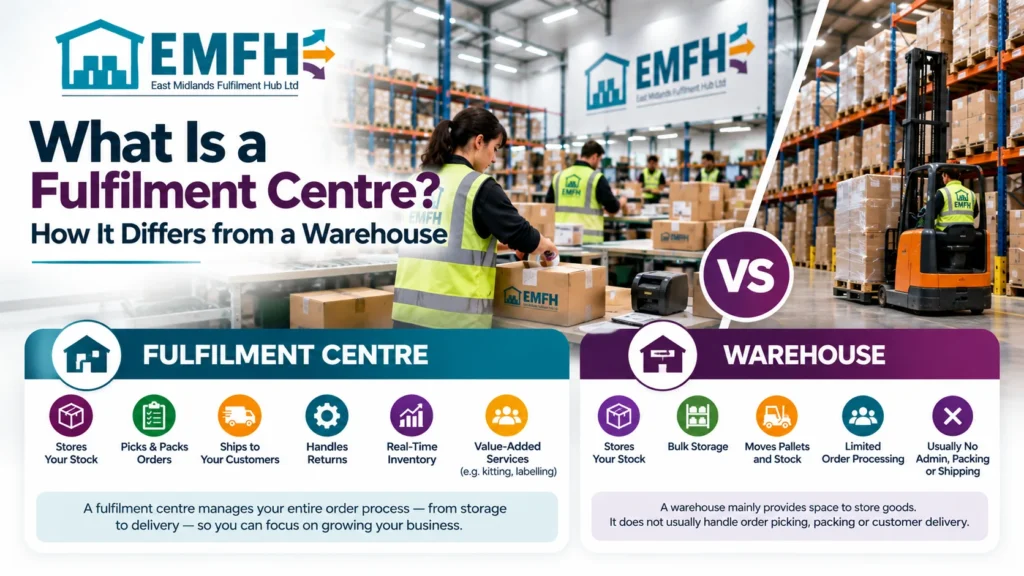
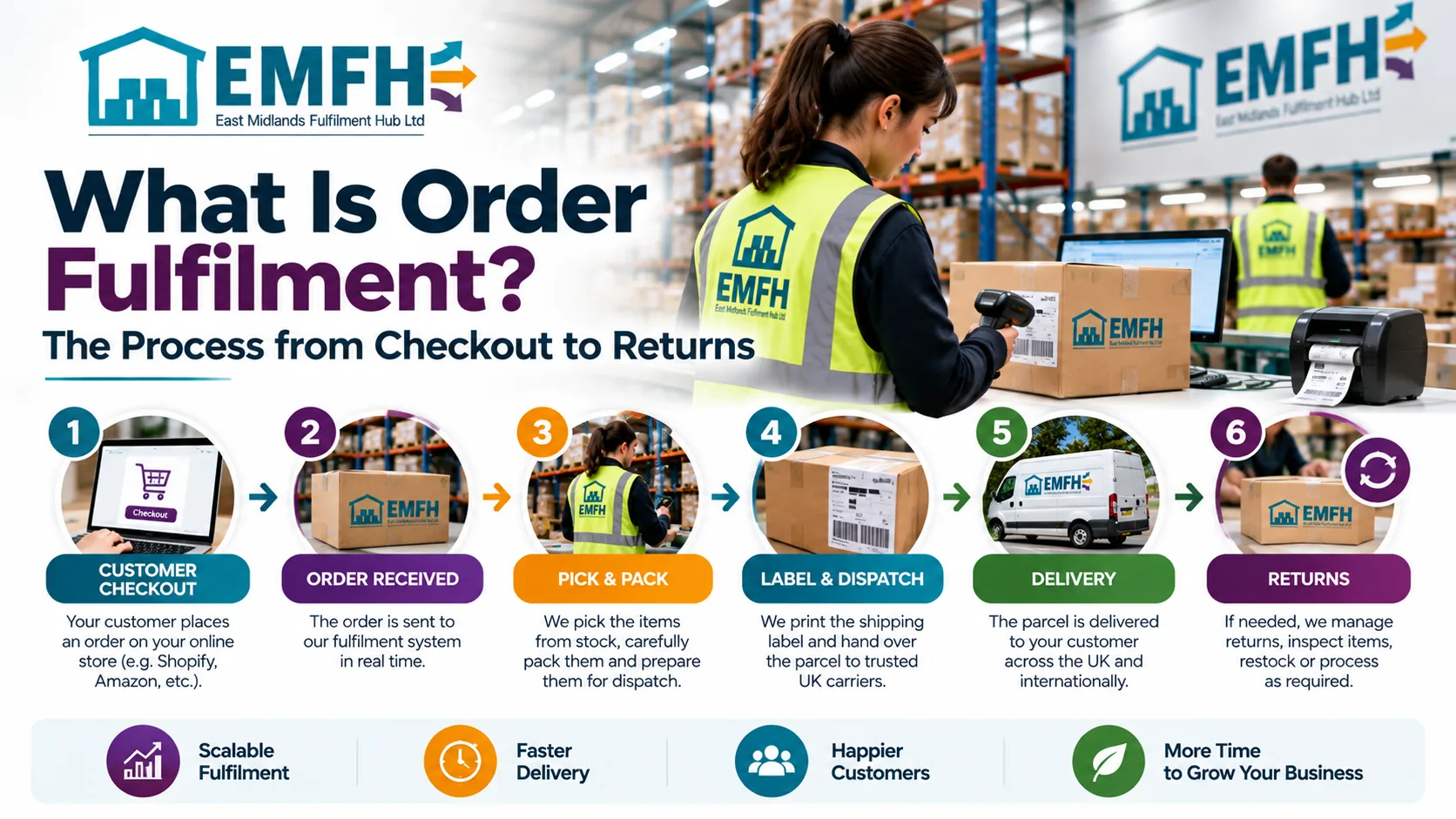
A fulfilment centre is a facility that stores products and prepares customer orders for dispatch. Its role goes beyond holding inventory: it connects stock, order processing, picking, packing, carrier handover and returns in one operational workflow.
For a UK online retailer, the useful question is whether a facility can handle your particular products and order patterns. The label on the building tells you less than its processes, systems and agreed service levels.
Fulfilment centre versus warehouse
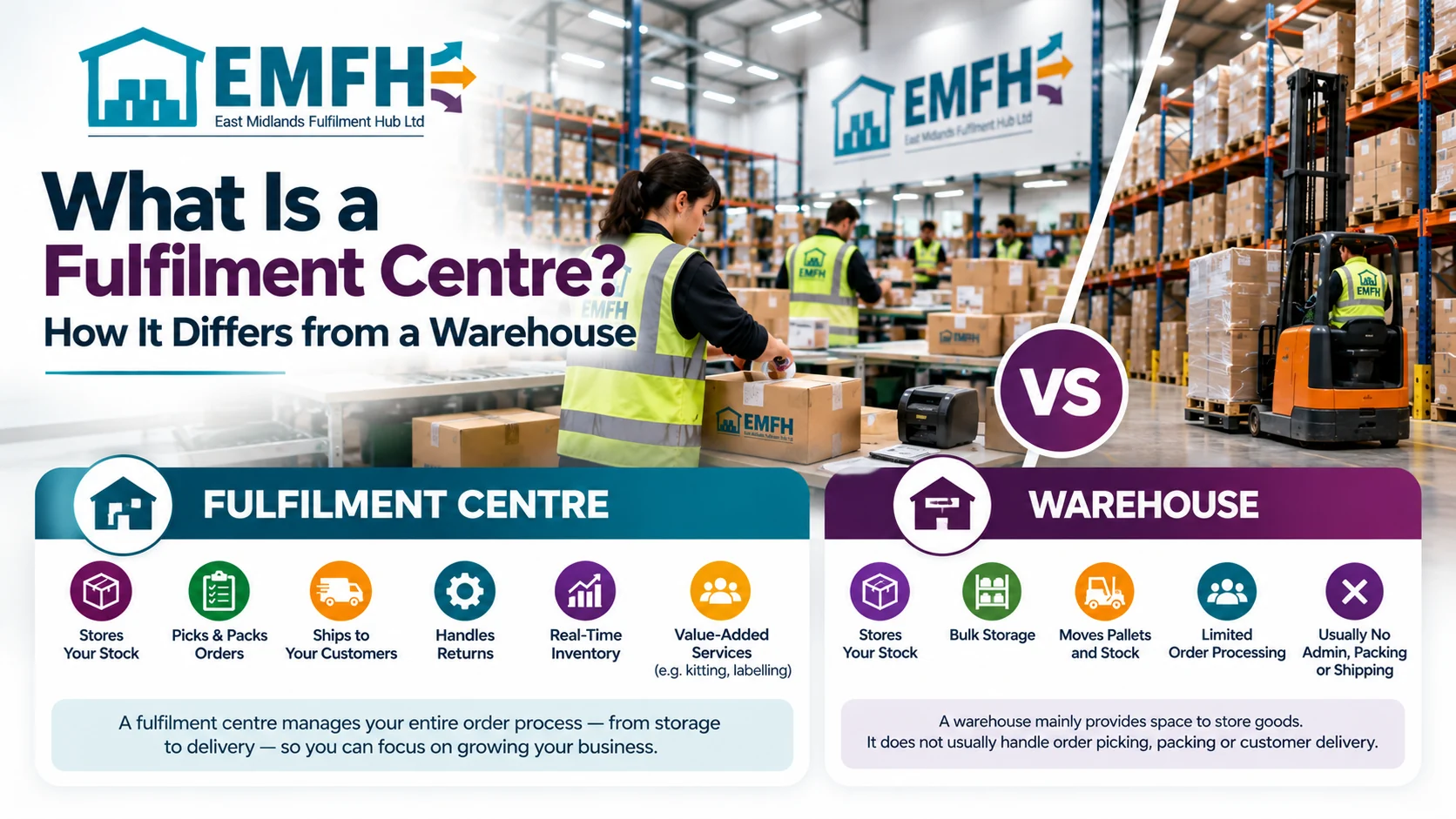
A warehouse is a place for storing goods. A fulfilment centre is a warehouse operation organised around completing orders. Many facilities do both, so this is a distinction in function rather than a rigid difference between building types.
| Requirement | Storage-focused warehouse | Fulfilment operation |
|---|---|---|
| Main activity | Holding and moving stock | Preparing and dispatching customer orders |
| Typical movement | Pallets or cartons in and out | Stock receipts plus frequent item-level picks |
| Information needed | Quantities and storage locations | Those records plus customer order and shipping instructions |
| Returns | Depends on the storage agreement | Can include order-linked inspection and restocking |
Check the actual proposal. A storage provider may offer excellent fulfilment capabilities, while a facility marketed as a fulfilment centre may exclude work that your products require.
What happens inside a fulfilment centre?
Receiving and put-away
Staff check incoming goods, identify differences and record where accepted stock is placed. Clear supplier labels and accurate advance delivery information reduce avoidable investigation.
Inventory control
The warehouse system connects products to locations and quantities. Saleable, reserved and quarantined stock should remain distinguishable. Counting routines and exception reporting help maintain that record as goods move.
Order preparation
Eligible orders move into picking and packing. Staff select the right variants, check quantities, protect the contents and prepare the requested delivery service. Read about EMFH’s pick and pack service.
Dispatch and returned goods
Parcels are prepared for carrier collection and tracking details are recorded. Returns follow a separate workflow so a received item cannot accidentally become available for sale before inspection.
Why location matters, and what it cannot guarantee
A central location can help a retailer access carrier networks and manage inbound journeys. EMFH is based in Nottingham in the East Midlands, serving businesses that need UK fulfilment support.
However, a postcode alone does not guarantee faster delivery or lower costs. Ask about collection times, the actual services available for your parcel sizes, destination coverage and peak-period arrangements. Compare those details with where your customers live and where suppliers send stock from.
What makes a facility suitable for your products?
Start with physical needs. Large products require different handling from small accessories. Fragile items need repeatable protective packaging. Products with batches or expiry dates require relevant traceability and stock-rotation processes.
Then examine operational fit. Can the facility process your usual basket size, bundles, retailer instructions and returns decisions? Discuss any regulated, hazardous, temperature-sensitive or unusually valuable products before arranging delivery. Acceptance and handling requirements must be confirmed specifically.
A practical facility visit checklist
- Follow a sample SKU from receipt to storage and then to an order.
- Ask how damaged or unidentified inbound goods are separated.
- See how similar product variants are checked during picking.
- Review how missed collections and stock discrepancies are reported.
- Discuss access to inventory information and the stock-count process.
- Ask how returned goods are prevented from mixing with approved stock.
Look for a clear explanation rather than an impressive tour alone. A strong process should be understandable and repeatable when the usual account contact is away.
Frequently asked questions
Is a fulfilment centre the same as a distribution centre?
The terms overlap. A distribution centre may focus on moving larger shipments to businesses, while ecommerce fulfilment often involves individual customer orders. Ask which workflows a provider actually supports.
Can I store stock without outsourcing all my orders?
Some providers offer separate storage and fulfilment arrangements. Confirm minimum charges, stock access and outbound handling terms.
Do I need a centre near my office?
Not necessarily. Supplier routes, customer destinations, carrier collections and communication can matter more than proximity to your desk.
Six operating areas inside a fulfilment centre
A useful way to assess a facility is to follow the work rather than count the shelves. Products move through receiving, storage, replenishment, picking, packing and dispatch, while returns and exceptions need their own controls. The layout can vary, but staff and system records should describe the same product, quantity and status at each stage.
1. Receiving and discrepancy handling
The receiving area connects supplier documents with the goods that actually arrive. A fulfilment centre needs product identifiers, expected quantities, packaging units and the agreed inspection requirements. Staff should be able to record a short delivery, damaged carton or unknown item without forcing it into available stock. Confirm how your team receives that information and who can approve the next action.
Discuss unloading and booking requirements before sending a delivery. A proposed arrival time is not the same as a confirmed receiving appointment. Ask what information must arrive in advance and how a late or changed delivery is handled. The aim is to make goods-in predictable enough for accurate checks, not simply move products away from the vehicle quickly.
2. Storage locations and stock status
A storage location identifies where stock is held. A status identifies whether it can be sold, picked, reserved or moved. A fulfilment centre may physically hold a unit while waiting for inspection or an owner’s decision. That unit should not be confused with approved stock merely because it appears in the building’s total quantity.
Ask how reserve storage, pick locations and replenishment are recorded. A fast-moving product can need accessible picking stock as well as a larger reserve quantity. Confirm the rule for replenishing the pick location and how an incomplete movement is investigated. Clear location records help distinguish an empty pick face from a genuine shortage of the product.
3. Picking and variant identification
Picking turns order instructions into a physical collection of products. Similar sizes, colours or packaging can be difficult to distinguish without consistent identifiers. Give the fulfilment centre accurate SKUs, readable barcodes where used and reference images when useful. Agree how case quantities, individual units and kits are represented so staff do not have to infer the intended unit of measure.
A picking demonstration should include your awkward examples, not only a simple single-item order. Ask what happens if stock in the expected location is missing or damaged. Identify who can approve a substitution, partial shipment or hold. An urgent order should still follow an agreed exception route rather than bypassing product and quantity checks.
4. Packing standards and material availability
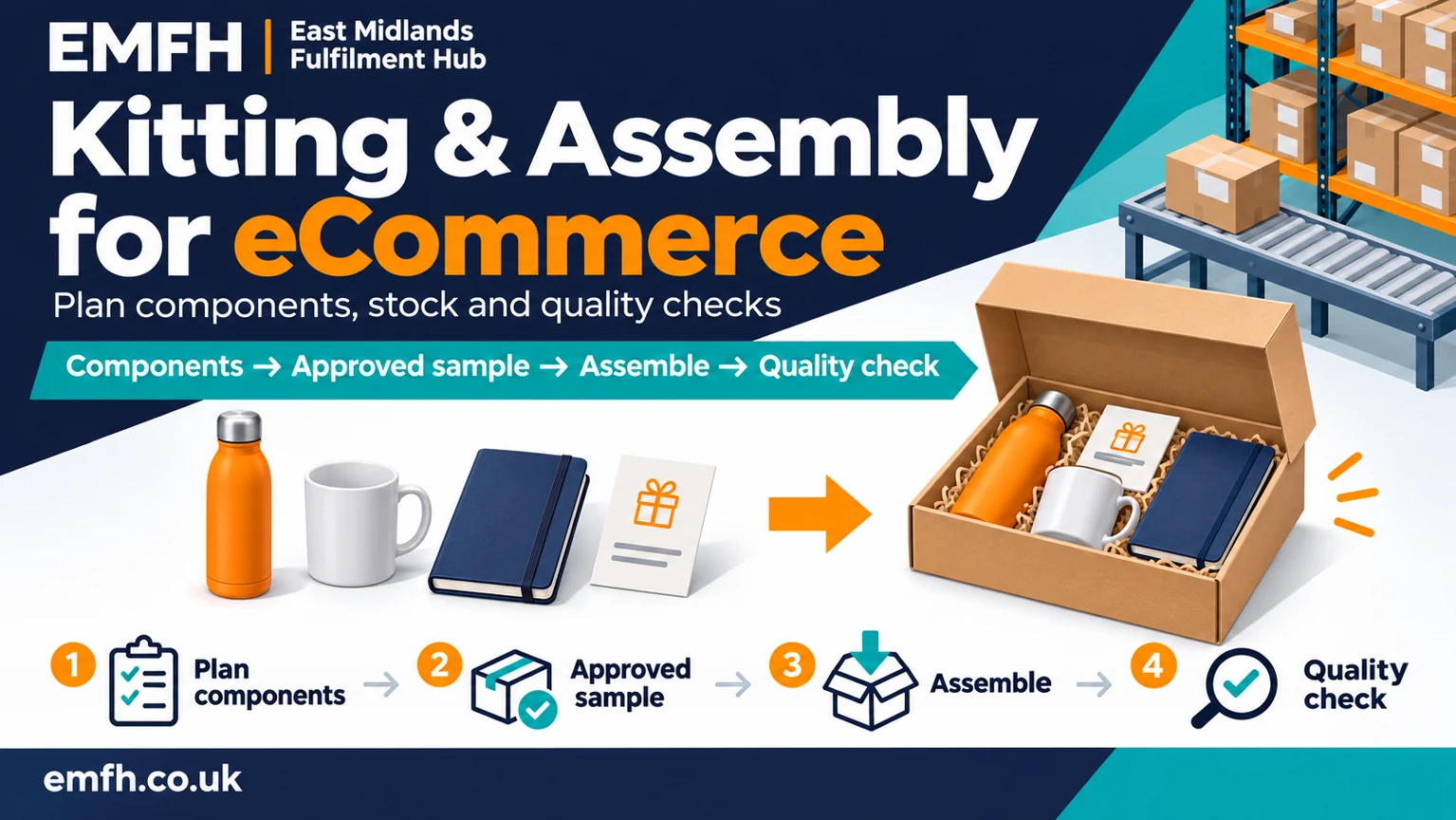
A packing area needs instructions describing protection, presentation, labels and any inserts. Approve representative samples for fragile, multi-item and unusual orders. A fulfilment centre should know which materials can be substituted and which changes require permission. Keep the approved version current when a product or packaging design changes.
Include packaging stock in replenishment planning. A product may be available while its branded mailer or component is not. Agree how low supplies are reported and who approves an alternative. For retailer loads, confirm the recipient’s labels and documentation. Where logistics-unit identification is required, review GS1 UK’s SSCC and logistics-label guidance alongside the current customer specification.
5. Staging, collection and dispatch records
Prepared parcels or loads need an identifiable route to the correct carrier or collection. Ask how the fulfilment centre separates services and records the handover. A printed label is not evidence that the shipment has been collected. Check what information is available when an order appears dispatched in one system but has not yet shown movement in another.
Review missed collections and service changes as well as the normal schedule. Who can select an alternative, approve a cost change or inform customer service? Keep dispatch performance separate from delivery performance. The selected carrier’s service and destination conditions still matter after the warehouse has completed its agreed work.
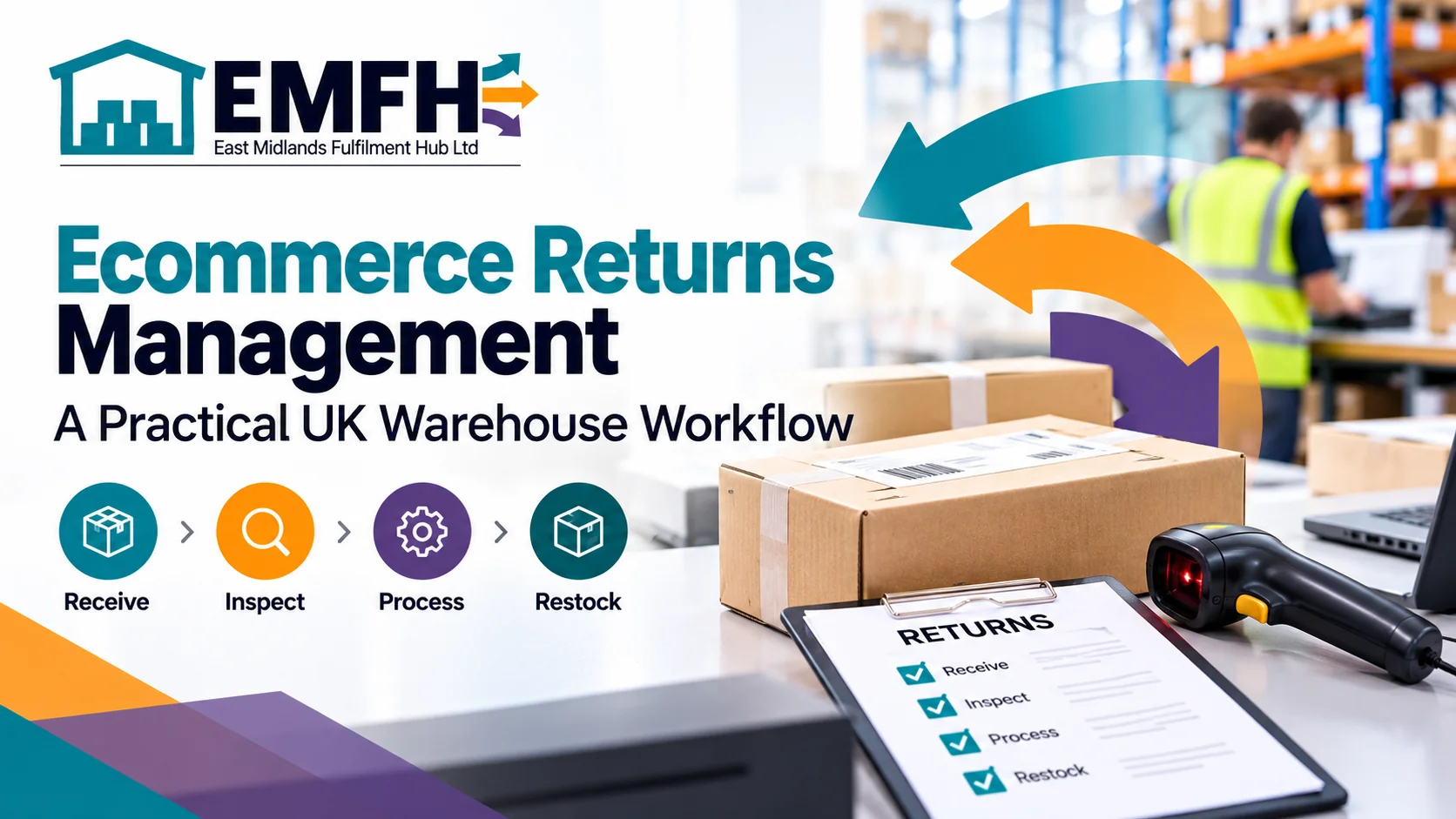
6. Returns, quarantine and authorised outcomes
Returned products need identification, an inspection standard and a stock decision. A fulfilment centre should distinguish receipt from approval to sell again. Agree what evidence is recorded, which conditions permit restocking and which outcomes require your team’s authorisation. Keep incomplete kits and unidentified returns in a status that prevents accidental sale.
Discuss how returned goods move back into stock after approval and how the update reaches your sales channels. Record rework, damaged units and authorised disposal separately. A quick inspection process is useful only when its outcome is understood by both the warehouse and the business deciding the customer response.
A worked fulfilment centre stock-flow example
This is an illustrative example, not a claim about an EMFH account. A facility receives 240 units of a product. Of those, 230 pass the agreed check and 10 are held for a condition decision. The inventory record accounts for all 240, while only the approved quantity can be made available for the agreed order flow.
The team places 30 approved units in a pick location and 200 in reserve storage. After a 12-unit order is dispatched, the expected approved quantity is 218. If the pick location needs replenishment, the movement from reserve changes the locations, not the total stock owned by the account. A replenishment should therefore not be mistaken for a new receipt.
Ask a prospective fulfilment centre to show those events in the system and explain the physical controls. If a later count finds only 17 units where 18 are expected, investigate the movement and order history before adjusting the balance. Keep known held quantities separate from an unexplained shortage so the account can identify the actual issue.
Turn a facility visit into a practical assessment
Arrange the visit with the provider and agree what can be demonstrated. Bring an operating brief, a few product examples where appropriate and the questions that matter to your account. Do not treat warehouse size, appearance or proximity to your office as a substitute for product suitability, process control and the service scope being proposed.
During a fulfilment centre visit, follow one representative product through receipt, storage and order preparation. Ask how exceptions are escalated and what changes when the usual account contact is away. The explanation should connect the physical activity, system record and decision owner. Record any capability still requiring a test after the visit.
Questions that reveal the exception process
- What happens if a supplier delivery has the correct total but the wrong variant mix?
- How is an unknown or damaged product kept out of available stock?
- Who can approve a packing substitution or short shipment?
- How is an order stopped after a cancellation request?
- What records support investigation of a missed carrier collection?
- How does an inspected return become available again?
A fulfilment centre does not need the same answer for every account. It needs a supported workflow for your requirements and a clear way to approve exceptions. If a capability is proposed but has not been demonstrated, record the acceptance condition. A later configuration change should be tested before being treated as a completed solution.
Information the fulfilment centre needs from your business
Send a product file with SKUs, dimensions, weights and relevant handling information. Include normal and peak stock holding, supplier delivery patterns, order volumes, items per basket and destinations. Describe sales platforms, retailer requirements, assembly work, returns and any important launch dates. Separate actual history from forecast activity.
Explain special requirements before booking stock in. A product restriction, temperature requirement or high-value handling need must be assessed specifically. Do not assume a general warehouse description covers it. Ask the fulfilment centre to confirm scope, exclusions, charges and the information still needed to approve the operation.
Review the operation after the first live period
Compare receiving differences, stock movements, held orders, dispatch confirmations and returns decisions with the agreed workflow. Review repeated exceptions by cause. A missing SKU, unclear packing brief and picking mistake require different corrections, even if each results in an order being delayed. Keep an owner, action and outcome for material issues.
Check billed quantities against the activity records provided under your agreement. Storage measurement, additional picks and special jobs can affect the total. Use our fulfilment costs guide to keep quantities, rate units and assumptions separate. A facility assessment is stronger when the first invoice and operating results can be compared with the original proposal.
Review the fulfilment centre scope when your product range, channel mix or order profile changes. A new bundle or retailer can introduce work the previous arrangement did not cover. Keep product data, approved instructions and escalation contacts current. The building supports the operation, but the repeatable process is what turns stored products into completed customer orders.
Prepare the first delivery to a fulfilment centre
Before stock moves, confirm the product file, receiving appointment, delivery references and inspection brief. Agree how the warehouse should report a difference and who can decide the outcome. Check whether any labels, carton information or product preparation must be completed by your supplier. Keep those instructions consistent with the actual delivery.
- Approved SKU list and variant identifiers.
- Expected quantities and packaging units.
- Booked receiving window and delivery reference.
- Handling restrictions and agreed inspection checks.
- Opening stock reconciliation and availability rule.
- Named contact for discrepancies and urgent decisions.
- Sample-order approval before the planned live scope begins.
Do not release live orders against an unverified opening balance. If receiving finds a shortage, damaged units or an unknown product, record the difference before deciding how to update availability. A fulfilment centre handover is complete when the physical receipt and system record are reconciled under the agreed rules, not merely when the vehicle has been unloaded.
Read the reports by stage
Ask which records are available for received quantities, stock status, order holds, dispatch and returns. Each answers a different question. A total stock number does not show whether all units are saleable, and a prepared order does not prove carrier collection. Keep the event definitions clear so your team can recognise what is complete and what still needs action.
For a held transaction, look for the reason, time recorded, decision owner and next step. Review the oldest unresolved cases and recurring causes. A fulfilment centre dashboard is useful when it directs attention to a decision, not only when it presents a large amount of data. Agree how your team can obtain the supporting transaction history for a discrepancy.
Use those records during routine reviews and before changing the operation. A new packing standard, allocation rule or retailer workflow should have an approved brief and a test result. Retain the previous version so later questions can be traced to the instruction in force at the time. This makes the service easier to understand and manage as requirements evolve.
Explore fulfilment support in Nottingham
Learn what fulfilment includes, review EMFH’s services or talk to the team about your stock and order requirements.